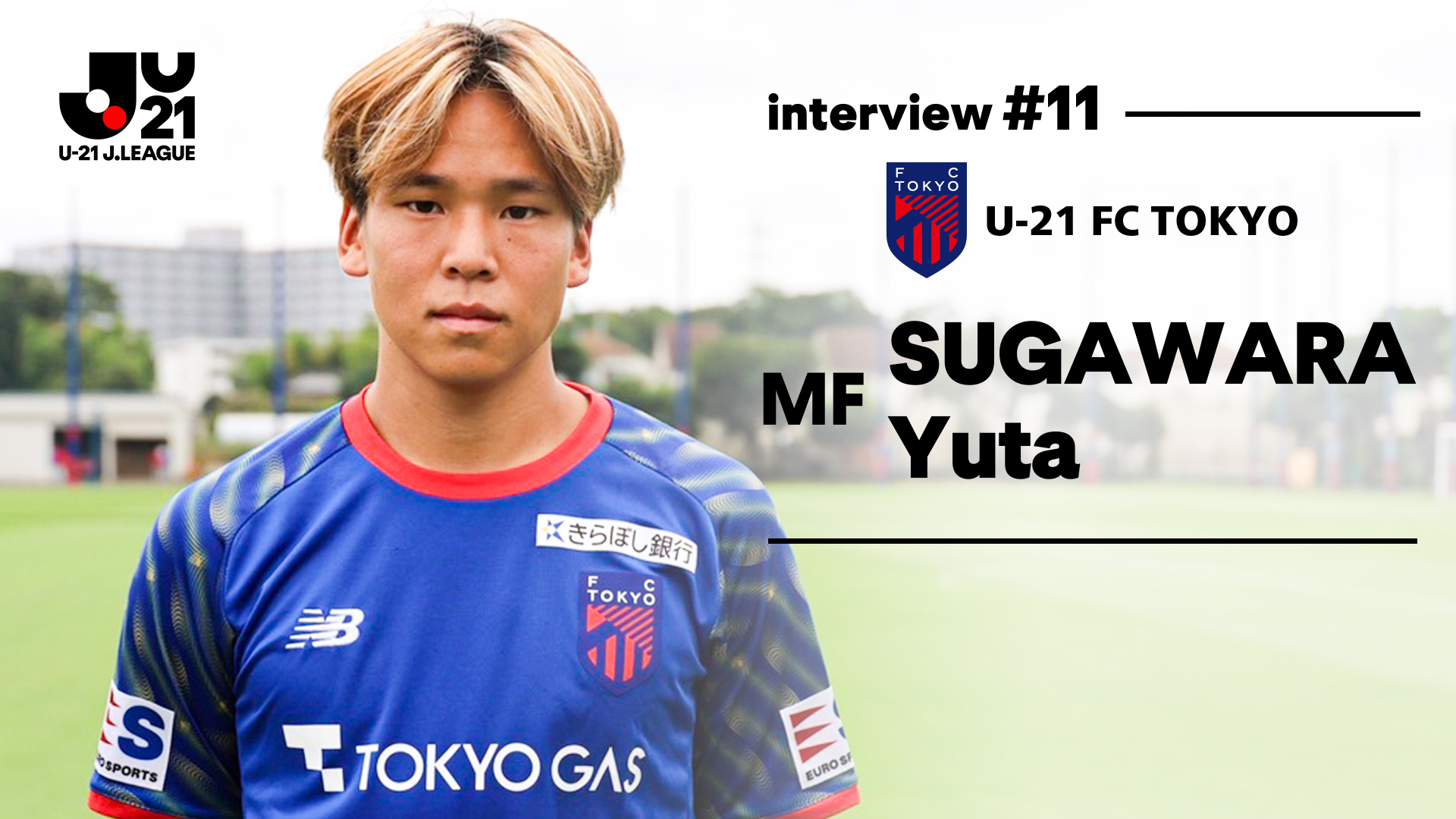
The U-21 J.League kicks off on 22 August. Newly established to accelerate the development of Japanese football and give young players a stage on which to challenge themselves, the league will bring together talent with the potential to represent Japan at senior level in the years ahead. In Poised to Pounce, we take a closer look at the careers and personalities of the next generation of players expected to make their mark. In the eleventh and final instalment, we hear from FC Tokyo’s gifted left-footed attacker Yuta Sugawara.
■ JACPA Tokyo FC — where he met ‘Ryu-chan’, Ryunosuke Sato
Sugawara has carved out the future he imagined with the left foot he has spent years honing. He trusts that same weapon to carry him through whatever challenges come next. His sights are set on the world. He sees a straight path ahead, one that he hopes will eventually make him a millionaire.
“If I play in the U-21 J.League, it’s a chance to show what I can do at my best and, most importantly, produce results. That’s a clear way to make my case, and ultimately I want to turn those performances into opportunities in the J.League.”
Now wearing the blue and red shirt he admired as a child, the young left-footer has his sights set on an even bigger breakthrough. Yuta Sugawara is ready to keep pushing forward, waiting for the right moment to make his mark.
His father was a devoted FC Tokyo supporter, and football was Sugawara’s passion from kindergarten. Even then, kicking a ball around in the playground, he was already doing it with his left foot.
The first team he joined was FC Hoya, the local side associated with his primary school.
“I was playing with the fourth-graders when I was in first grade, so I guess I must have been pretty good.” [laughs] “But what I remember most is being able to play freely. That was the team where I first learnt how much fun football could be.”
In third grade, Sugawara moved to JACPA Tokyo FC, where he was already attending football school. It was there that he met a player one year older who would become someone he looked up to.
“Ryu-chan and I became friends at the football school when I was in second grade. Even back then he was playing up with older age groups, and I remember thinking, ‘Wow, this guy is really good.’ He already had that presence about him.”
‘Ryu-chan’ is Ryunosuke Sato, who moved from FC Tokyo to Valencia CF in Spain this summer. Few could have imagined that the senior player Sugawara met in primary school would go on to be his team-mate at junior high, high school and eventually professional level.
Coached by Kenta Saito, Sugawara’s age group developed into one of the strongest teams in Tokyo by the time they reached sixth grade. In the semi-finals of the Tokyo qualifiers for the JFA U-12 Japan Football Championship, they faced Tokyo Verdy Junior. Their seniors had lost to the same opponents in the final the previous year, adding extra significance to the match, but JACPA were beaten 1-0.
“We were on top for a lot of the game, but we couldn’t take our chances. Then we conceded midway through the second half, and they saw the game out. It was really frustrating.”
The defeat denied them a place at the national tournament, but the high-level football Sugawara experienced during his time at JACPA laid important foundations for the player he would become.
■ The thrill of pulling on blue and red
By the time Sugawara was preparing to enter junior high school, the talented left-footer was attracting interest from several J.League academies. In the end, his attachment to FC Tokyo made the decision easy.
“I think it was Mother’s Day when my parents got the call. FC Tokyo told them, ‘We’d like to recruit him, so please think it over.’ I said yes straight away.”
“My dad was an FC Tokyo fan, so there were already photos of me wearing their shirt when I was little. Ryu-chan and Riku Kawamura had also gone from JACPA to Musashi, and I wanted to follow them. That’s why I chose FC Tokyo.”
Sugawara joined FC Tokyo U-15 Musashi. He still clearly remembers the excitement of receiving the blue and red kit for the first time as a member of the club.
“I was so happy when I got the kit. I took it home, put it on straight away and showed my parents. They were both like, ‘That looks good!’ and took loads of photos.” [laughs] “I was also really happy to be able to tell my dad that I was part of FC Tokyo now.”
Many of his U-15 Musashi team-mates were players he already knew from Tokyo prefectural and national development programmes, while the age groups above him were also packed with talent. Sugawara regularly played up an age group as he continued to develop.
He felt he made particularly significant progress during his second year of junior high school. Playing alongside older players such as Sato and Taiyo Yamaguchi, now with Tochigi SC, he gained valuable experience at a high level and was part of the side that won the Club Youth Championship that summer.
In August of his third year, Sugawara and team-mate Divine Chinedu Otani were called up to the U-15 Japan National Team for the ROOKIE CUP in J-VILLAGE. Wearing the Japan shirt for the first time gave him a greater sense of responsibility as a footballer.
Sugawara also remembers the influence of Ryuji Fujiyama, who coached him at U-15 Musashi.
“Coach Fujiyama probably knew that if he said too much to me, I’d start sulking.” [laughs] “So he didn’t overload me with instructions. But he was strict with me, and I think that brought out more of my competitive side. That was really good for me.”
Fujiyama found a way to challenge Sugawara while still giving him the freedom to develop in his own way.
From the summer of his third year, Sugawara also began regularly joining U-18 training. One episode from that period says plenty about his personality.
“Before one training session, Coach Okuhara told us, ‘Go and pair up with someone you think you can learn from.’ So I went straight over to Naoki Kumata.”
“Kumata had that presence about him, and he scored loads of incredible goals, so I thought, ‘I’ve got to go with Kumata.’ He was like, ‘Me?’” [laughs] “But we paired up for the drill. Once I spoke to him, he was really kind and funny.”
The fact that Sugawara had no hesitation in approaching Kumata, three years his senior and now with Iwaki FC, also shows his knack for connecting with older players.
■ Grateful to Takashi Okuhara — the year ‘I improved the most’
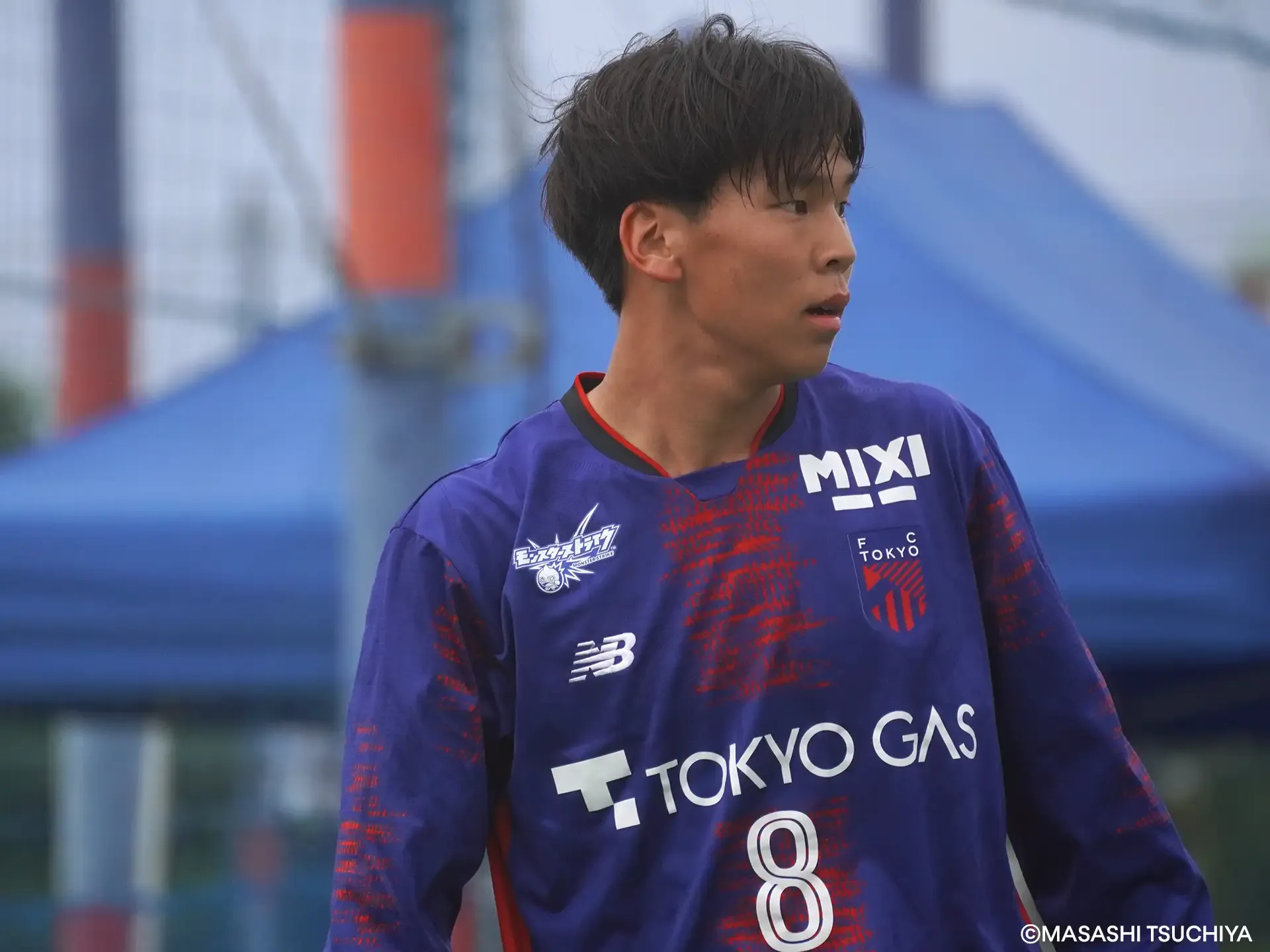
After graduating from junior high school, Sugawara moved up to FC Tokyo U-18. In the U-18 Premier League, the highest level of competition in Japanese youth football, he made his debut against Shoshi High School in Matchweek 3 before being handed his first start against Aomori Yamada High School the following week.
Still only 15 and surrounded by older players, Sugawara steadily established himself at left-back.
Although his natural position was further forward, being used at left-back was part of what made his first year under Takashi Okuhara such an important period. Sugawara still considers it the year in which he made the greatest progress of his career.
“I think I’m the player I am now because Coach Okuhara kept giving me chances back then. On the pitch, he cared about the smallest details, right down to a single millimetre, and he was always watching how we carried ourselves off it as well. A lot of what he told me has really stayed with me. I grew in every area that year, and I still feel it was the year I improved the most.”
FC Tokyo U-18 reached the final of the Club Youth Championship that season. Despite being a first-year player, Sugawara started all seven matches and relished the experience.
“Tournaments are so much fun because every time you win, you get another game. I never really felt tired, and it made me realise, ‘I really can run.’ Most of the players I was up against were in their final year of high school, but it gave me confidence that if I played my game, I could compete with them. It was a really good tournament for me.”
The final against Gamba Osaka Youth was still level at 3-3 after extra time and went to a penalty shoot-out. After Sato missed FC Tokyo’s first kick, the pressure fell on the first-year player wearing No. 33 as the second taker.
“It was already my second national final, so I went into the match thinking, ‘I’m just going to enjoy this.’ Ryu-chan missed our first penalty, but I just thought, ‘All right, I’ll score mine.’ I wasn’t nervous. I was feeling good at the time, and even before the shoot-out I had a feeling I’d be taking one, so I was confident.”
Sugawara calmly fired his penalty into the right corner.
FC Tokyo eventually lost the match, but the togetherness that developed over the course of the tournament remains an important memory.
“Before the tournament, Junpei Kojima, one of the final-year players, suffered an ACL injury. We all had this feeling of, ‘Let’s win it for him,’ and I think that was when the team really started to come together. I still remember how dramatic the whole tournament felt.”
■ A father’s smile, a mother’s tears — the joy of earning promotion
His second year of high school was a very different experience.
“I might have overestimated myself a bit. Maybe I got too confident.”
A series of minor injuries kept him out of several matches, while seeing team-mate Otani make his first-team debut in the Levain Cup and even score a goal only added to Sugawara’s sense of urgency.
The experience that prompted him to reassess where he stood came at the start of the following year, when he joined the first team’s training camp in Okinawa. A week spent among professional players gave him a stark reminder of the level he still had to reach.
“I went into camp determined to give it everything, but honestly, I was nowhere near good enough. The speed of decision-making and the tempo of play were completely different. If you wait until you have the ball to start thinking, it’s already too late. Afterwards, I realised I had to keep thinking all the time, even before the ball came to me.”
“Maki Kitahara stayed with the first team for the whole camp and then went on to play in J1. I couldn’t help thinking that if I’d performed better than Maki, maybe I could have been the one playing in J1. It was frustrating to lose out to him, especially because he’s younger than me and also came through JACPA. But it made me realise I needed to improve, so in that sense it was good to see where I really stood.”
One of the matches that stands out most from Sugawara’s third year came in the final group-stage fixture of the Club Youth Championship against Avispa Fukuoka U-18.
FC Tokyo were 3-1 down midway through the second half and facing elimination if they lost. Then the match changed completely.
“If we’d been the team we were before, I think we would’ve just lost that game. But I set up Divi to make it 2-3, then I scored to make it 3-3, and we ended up winning 5-3. Everyone was really up for it, we showed some real fight and we got the result. It was a great game.”
Their final national tournament as academy players ended with a penalty shoot-out defeat to Kashima Antlers Youth in the semi-finals, leaving them just short of the title. Even so, the week they spent together that summer, united in pursuit of a national championship, became a lasting memory.
Sugawara was told whether he would be promoted to the first team shortly before the Club Youth Championship. Accompanied by both of his parents, he went into a familiar meeting room at the clubhouse.
“At that meeting, you were basically told one of three things: no promotion, on hold or promotion. I thought mine would be deferred, so I was already thinking, ‘Right, I’ll just have to prove myself at Club Youth.’”
The answer was promotion.
His mother was in tears almost immediately.
“My mum cries really easily, so she was crying a lot. My dad suddenly got really excited — he was like, ‘This is amazing!’” [laughs] “I think he was just so happy that his son was turning pro at the club he loves.”
“I felt lucky to have parents who were so happy for me that they cried. It made me feel like maybe I’d managed to give something back to them. But I want them to see me actually doing well as a professional too, so it made me want to work even harder.”
Inspired by his father and having admired FC Tokyo since childhood, Sugawara had achieved his dream of becoming a professional footballer with the club he had always wanted to represent.
■ Yuto Nagatomo and Masato Morishige — learning what it means to be a professional
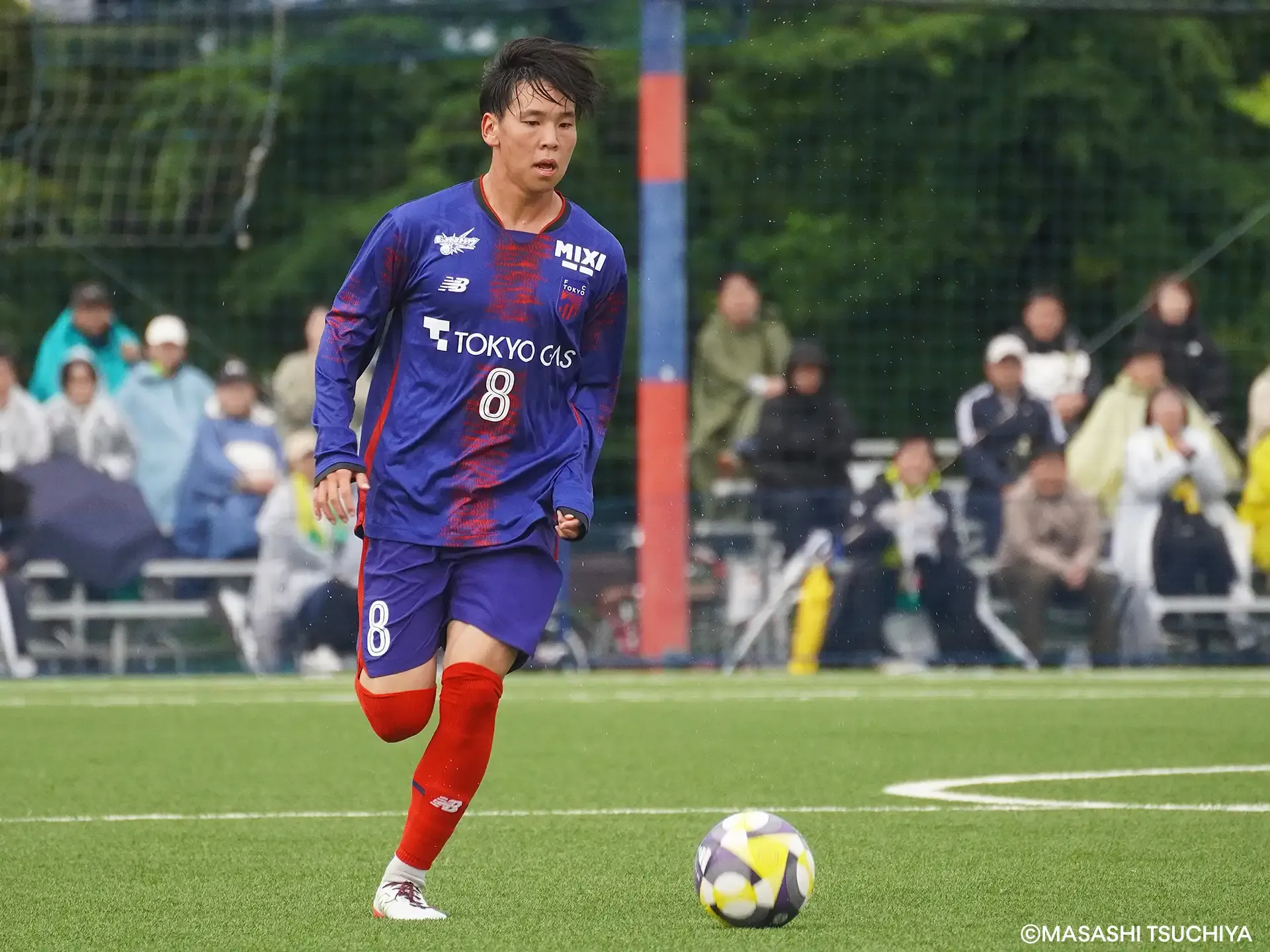
Now that the game he has always loved has become his profession, Sugawara is learning what it really means to be a professional footballer. Two experienced players who have competed on the international stage have had a particularly strong influence on him.
“At first, I was always thinking, ‘What does being a professional actually mean?’ Then I saw how disciplined Yuto Nagatomo is and thought, ‘Right, this is what a professional looks like.’ He’s incredible.”
“I asked Masato Morishige what he was like in his first year as a pro. He told me things I’d never heard before, like, ‘I got a bit full of myself at Oita.’ I was really happy he shared things like that with me. Having those two around is huge for me. Their experiences can teach me so much, so I’m really grateful that I get to hear those stories.”
Sugawara was given one opportunity to play in the MEIJI YASUDA J1 100 YEAR VISION LEAGUE.
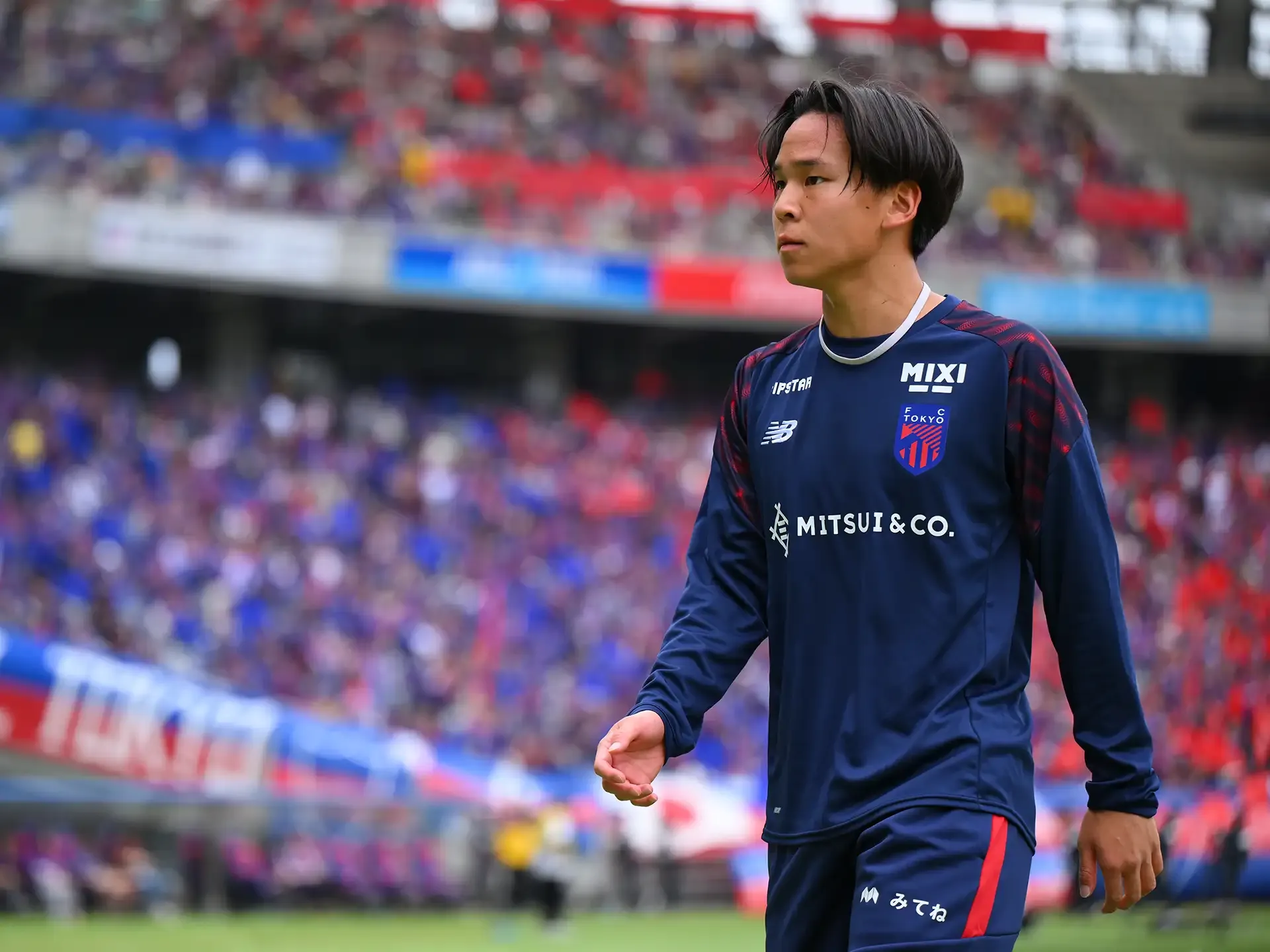
On 1 April, FC Tokyo travelled to FC Machida Zelvia for Regional League Round EAST Matchweek 11. With his side leading 3-0, the No. 21 rookie came on in the 87th minute to make his first-team debut.
“I was really excited. As soon as I knew I was in the squad, I was thinking, ‘If I get on, I’m going to make something happen.’ I only had a few minutes and didn’t get many touches, but I was really happy to play for the first team. My family were watching from the stands too, so I’m glad they got to see me out there on the pitch.”
He had less than 10 minutes on the pitch and did not record a goal or an assist. It was not a spectacular debut, but it was a significant first step nonetheless. Having experienced the atmosphere of professional football from the pitch for the first time, Sugawara will use it as motivation as he waits for his next opportunity.
■ ‘I’m ready to step onto the pitch at Ajinomoto Stadium at any time’
The 2026/27 J.League season gets under way in August, alongside the inaugural U-21 J.League. Sugawara’s approach is already clear: wherever he is asked to play, he intends to fulfil his role and make himself more valuable to the team.
“Being able to play in the U-21 J.League is important for staying match-sharp. If I play there, it’ll also show me what I still need to improve, and that will give me even more hunger to push for J.League matches. I know that if I produce results, my standing in the team can change, so I’m really glad we have a league like this.”
“I’m always thinking about using my left foot to make things happen in front of goal and then celebrating with my FC Tokyo team-mates. I’m ready to step onto the pitch at Ajinomoto Stadium at any time, so I want to make sure I’m so well prepared that I can say, ‘I’m ready whenever you need me.’”
The day when a single strike from his left foot sends the blue-and-red stands into celebration may not be far away.
With natural flair backed by the work he puts in every day, FC Tokyo’s young left-footer continues to develop. The moment Yuta Sugawara shows what his ‘magical’ left foot can do on the big stage is one to look forward to.
Interview and text by Masashi Tsuchiya