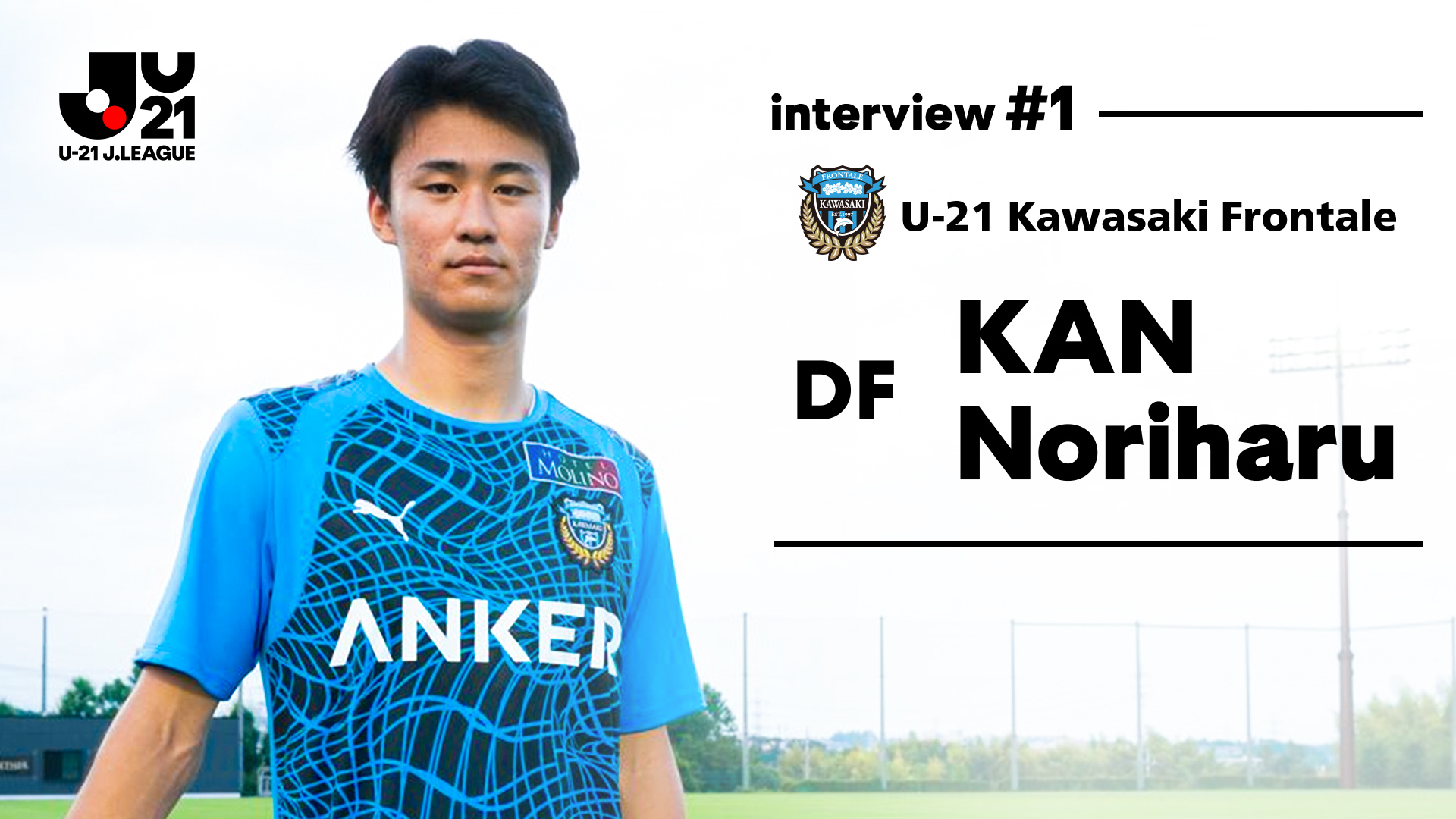
The U-21 J.League kicks off on 22 August. Newly established to accelerate the development of Japanese football and give young players a stage on which to challenge themselves, the league will bring together talent with the potential to represent Japan at senior level in the years ahead. In Poised to Pounce, we take a closer look at the careers and personalities of the next generation of players expected to make their mark. In Part One, Kawasaki Frontale’s towering full-back Noriharu Kan looks back on a life shaped by football.
■ A best friend who opened the door to Frontale
Kan has made up his mind: he will become a player who can make his mark on the world. There may be nothing concrete to back that up yet, but the belief is there. Kan knows both the pride of making football his profession and the fear that comes with trying to make a living from the game. So he will do everything he can, determined to seize the future he has set his sights on.
“When you look around the world, you see players like Lamine Yamal and Pau Cubarsí of Spain — both born in 2007, like me — already making an impact at the World Cup. I may still be young, but I don’t feel I have all that much time. That’s why I want to work even harder than before.”
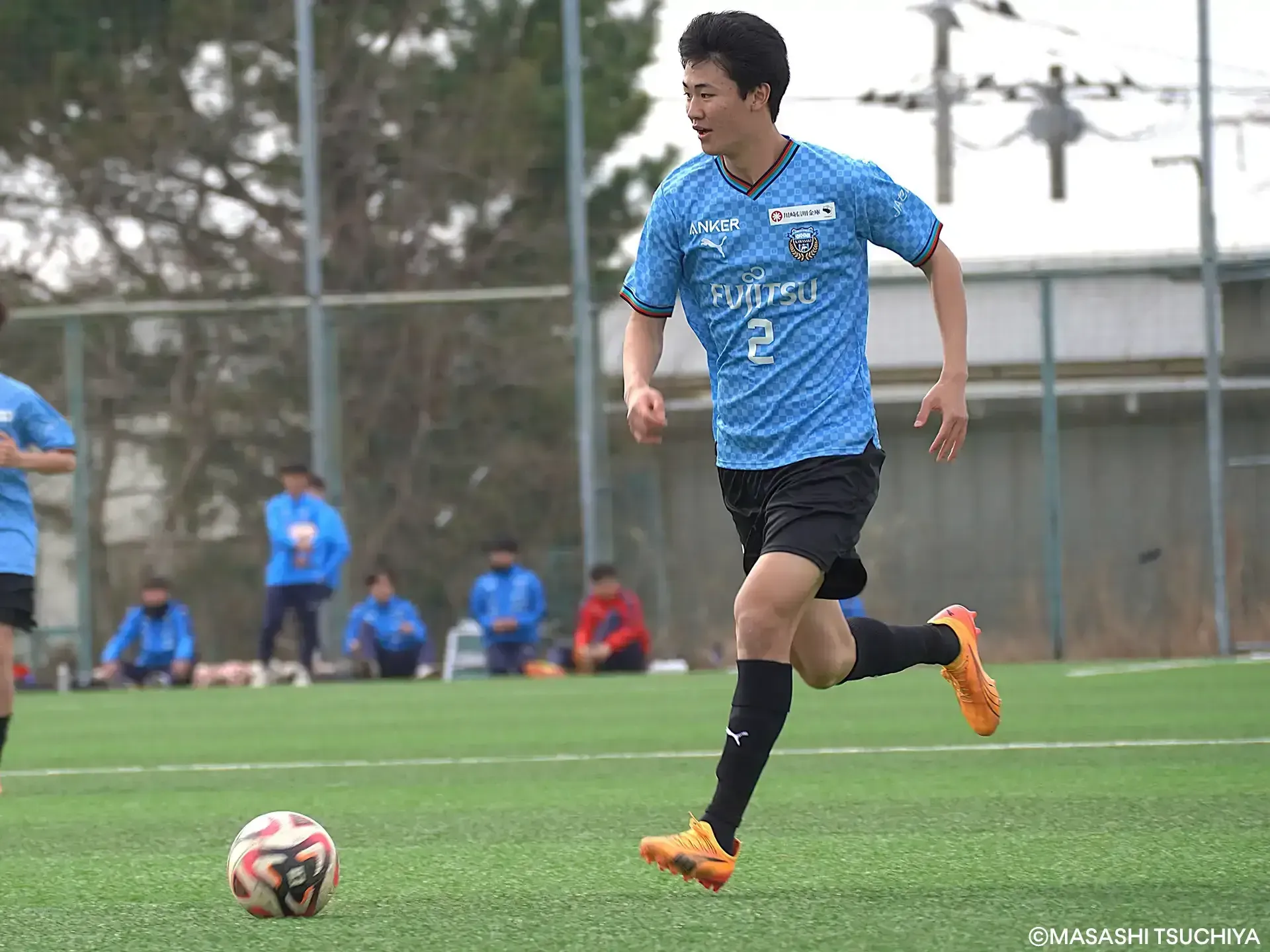
With his imposing frame and aggressive style of play, Kawasaki Frontale’s young full-back brings real dynamism to the pitch. Noriharu Kan surges up the touchline with pace and power, working day after day at the club’s Asao training ground with his sights fixed on the day he can set the crowd alight.
Kan first discovered football at the age of three. Seeing children around his age kicking a ball about in the playground of a nearby primary school made him want to join in. Matsugaya FC normally only accepted children from their first year of primary school, but they made an exception for him. At that age, though, there were apparently times when he was more interested in playing in the sand than in training.
Matsugaya FC were a small side who could barely get eight players together. But the simple enjoyment he found there would have a lasting impact on Kan’s career.
“We’d dribble, support the player on the ball, and if the ball came loose, we’d just get on it and dribble again — that sort of team. But it was really just, ‘Let’s enjoy playing football.’ It was a time when I simply came to love the game.”
Born and raised in Hachioji, Kan grew up with FC Tokyo as a familiar presence. He also attended trials for Tokyo Verdy Junior, although he did not make the team. His first connection with Frontale, meanwhile, came through someone who would go on to become his best friend.
“I’ve known Haruki [Haruki Kusuda, Rikkyo University] since around our first year of primary school. We used neighbouring stations, and our primary schools were next to each other as well. When I heard he was going to a Frontale trial, I said, ‘All right, I’ll go too.’ We went together and both got in. In the end, Haruki and I travelled to training together from our fourth year of primary school all the way through to our final year of high school.” [laughs]
■ A heartfelt message from ‘Tama-san’, the mentor he still looks up to
Kan joined Frontale at U-10 level alongside Kusuda and frequently played with the age group above him. In his fifth year of primary school, he was part of the side that won the JFA U-12 Japan Football Championship, alongside older players including Rio Tadokoro, now with Kochi United SC, and Takeshi Katori of Toyo University.
Kan himself did not get much playing time, but says with a laugh that his fondest memory is actually the “amazing hotel with a view of Sakurajima” where only the finalists got to stay.
The following year brought a very different experience. Frontale were knocked out in the semi-finals of the Kanagawa qualifiers.
“Our age group was good enough to win the national title again, but in the semi-final we lost 2-1 after going ahead against Buddy, a team we’d never lost to before. I remember crying so much that my legs cramped up.” [laughs]
The fact that Buddy SC went on to become national champions only deepened the disappointment.
It was during his U-12 years that Kan also met a coach he would come to regard as a true mentor: Seiichi Tamaoki, then a coach with the side and now manager of Kawasaki Frontale U-15 Todoroki.
“I call him Tama-san. I still remember the notes we exchanged in my football journal. When we travelled overseas, I had a Chinese passport at the time, so he helped me with getting visas and all sorts of things. He really did so much for me.”
Kan made a smooth transition to the U-15s, but once he entered junior high school, he began to enjoy spending more time with his friends. For a while, until after the summer of his second year, he struggled to commit himself fully to football. Once again, it was Tama-san who changed everything.
“Around the middle of my second year of junior high, I started playing with the team a year above me again, and Tama-san was the manager. I was still really immature in a lot of ways back then, and quite often I’d end up crying while talking to him before training.” [laughs]
“Neither my football nor my mindset was in a particularly good place at the time. Tama-san would be really tough with me, but afterwards he’d always build me back up. I’d play badly on Sunday, get told off before training on Tuesday, then he’d encourage me again. We went through that cycle over and over. But I think that was when I grew the most mentally.”
Recently, Kan received a welcome reminder that his former coach was still keeping an eye on him. When he earned his first call-up to the U-19 Japan National Team for the trip to France, a message arrived from Tama-san for the first time in a while.
“He sent me something like, ‘Congratulations on your national-team call-up. Give it everything.’ It made me think, ‘He’s still looking out for me.’ I’m really grateful for that.”
When Kan first joined Frontale at U-10 level, he was a full-back. His main position then shifted to defensive midfield in his final year of primary school, but Tamaoki moved him back to full-back in his third year of junior high. Kan felt that switch helped shape the way he sees football to this day.
■ The winter of his first year of high school: a harsh lesson at Todoroki
After stepping up to the U-18s, Kan initially found it difficult to adjust to the difference in physicality between junior high and high school football. But as he gradually settled into his new surroundings, his confidence grew. He was generally training with the A team and had begun to feel he could hold his own in intra-squad matches.
Then came a match that would prove a turning point.
At the 47th JAPAN Club Youth (U-18) Football Championship, Frontale faced V-Varen Nagasaki U-18 in their final group-stage match. Kan made his first appearance of the tournament with just over ten minutes remaining. He struggled to make an impact, and Frontale were also cut open down his flank in the move that led to a goal as they went on to lose the match. The experience was bitter enough to give the 16-year-old a real sense of urgency.
“That was the moment I clearly thought, ‘I have to do more.’ After the Club Youth Championship, I really started doing extra training and going to the park to kick a ball around. With strength work as well, rather than just going through the motions, I started working more closely with the trainer and putting much more thought into what I was doing.”
His debut in the Prince Takamado Trophy JFA U-18 Football Premier League came in unexpected circumstances.
On 10 September, Frontale travelled to Ryutsu Keizai University Kashiwa High School for Matchweek 13 in the EAST division. They were 1-0 ahead in the 59th minute when first-year defender Shunsuke Hayashi, who had started the match, was sent off for denying an obvious goalscoring opportunity.
Manager Yasuhiro Nagahashi — now a first-team coach and U-21 manager — responded by sending Kan, another first-year full-back, into central defence alongside Kota Yui.
Frontale U-18 held on to win 1-0 despite being down to ten men, and Kan made his presence felt as a makeshift centre-back.
“Obviously, the older players helped me a lot, but I think the change in my approach after the summer was starting to show. So I suppose I have Shunsuke to thank for making my Premier League debut there.” [laughs]
As the season entered its closing stages with Frontale chasing a second successive league title, Kan was handed a place in the starting line-up, and Frontale went on to record back-to-back wins over FC Tokyo U-18 and Kashiwa Reysol U-18.
They went into the final matchday in second place, two points behind leaders Aomori Yamada High School. The venue was Kawasaki Todoroki Stadium, where more than 3,400 spectators — an unusually large crowd for the Premier League — gathered for a decisive meeting with third-placed Shoshi High School, who still had a chance of winning the title.
Shoshi took the lead in the 14th minute. Frontale equalised in the 49th. Then, in the 82nd minute, Shoshi went back in front.
“My performance was so poor that I felt like we’d lost because of me… We’d lost our chance to win the title, and we couldn’t give the third-year players a win in their final match either. I just thought, ‘What am I doing…?’ It was really frustrating.”
The title had been within touching distance, only to slip away.
■ The summer of his second year: from elation to despair
Kan’s second year at U-18 level proved to be a breakthrough season. He started all 22 Premier League matches and firmly established himself as the first-choice left-back. Surrounded by older team-mates who gave him the freedom to express himself — among them captain Kaito Tsuchiya, now with Fukushima United FC — Kan continued to flourish.
At the 48th JAPAN Club Youth (U-18) Football Championship, he experienced both elation and despair. The elation came in the final group-stage match against Sagan Tosu U-18. All four teams in the group were level on three points, and when Vissel Kobe U-18 took a two-goal lead in the other match, Frontale found themselves needing to win by at least three goals.
But they refused to give in and produced a remarkable late surge.
59th minute: Shunsuke Hayashi.
60th minute: Hayato Hiratsuka.
67th minute: Takeshi Katori.
Fourth minute of stoppage time: Yutaro Onda.
Four goals in 15 frantic minutes gave Frontale a resounding 4-0 victory. Kobe U-18 also scored their third goal in second-half stoppage time, but Frontale advanced to the quarter-finals with a one-goal edge on goal difference.
“No matter how many times I think back on it, it genuinely feels like a miracle. Winning that match also gave us the confidence to think we could go on and win the tournament. That night might have been the most fun I had during my U-18 years.”
Despair followed in the final against Gamba Osaka Youth. Thunderclouds gathered over Ajinomoto Field Nishigaoka, and it was not long before heavy rain began to fall. Amid repeated changes to the organisers’ plans, the final eventually took the extraordinary form of a single 40-minute period. The match finally got under way at 20:15, more than two hours later than originally scheduled.
The two sides went at each other at full throttle. Gamba struck first, but Frontale turned the match around with quickfire goals from Shotaro Shibata, now at Meiji University, and Katori. Gamba, however, equalised two minutes into stoppage time.
Five minutes into stoppage time, Gamba Osaka Youth’s Takato Yamamoto, now with Borussia Dortmund, stepped up and sent a direct free-kick into the net.
Final score: 3-2 to Gamba.
“I think everyone would say the same thing — if we could play it again, we would. It’s the most frustrating memory of my U-18 years, and if I could, I’d go back to the day of that Gamba match.”
Even now, the regret and sense of loss from that day remain as vivid in Kan’s mind as though it had happened yesterday.
Kan’s phone lock screen, in fact, bears a phrase Nagahashi often used to tell him.
“I have a habit of mentally switching off during matches. So whenever play stopped for a moment, Nagahashi-san would shout from the bench, ‘Nori! No switching off!’ Everyone else would be getting tactical instructions — just not me.” [laughs]
“There’s no question in my mind that Nagahashi-san is the person who made me a professional footballer. Even now, during breaks in training, he teaches me all sorts of things — it’s almost like having a one-to-one lesson. He’s incredibly passionate. But then out of nowhere he’ll say something like, ‘I wish I could have been like you. I’m jealous of how tall you are!’” [laughs]
“I’m a Nagahashi kid through and through now.”
Kan’s gratitude to the mentor he is working with again this season runs deep.
■ The summer of his final year: inspired by Yu Kobayashi while sidelined
Kan entered 2025, his final year in Frontale’s academy, in excellent form. Taking part in the first team’s training camp had raised his day-to-day standards to another level, and he had carried that momentum through the off-season.
Then, in March, just before the Premier League campaign began, he suddenly felt something go in his right foot during a training match against Sanfrecce Hiroshima F.C Youth.
“To be honest, I was winning all my duels against Sanfrecce, and I was in really good shape physically. But when I planted my foot during the match, I heard a crack. The moment I heard it, I thought, ‘That’s it. I’m done.’”
The diagnosis was a fractured metatarsal in his right foot, an injury expected to keep him out for three months.
The setbacks continued. Kan returned before the summer and featured in the final Premier League match of the first half of the season. He had been looking forward to his final JAPAN Club Youth (U-18) Football Championship and a chance to make amends for the previous year’s defeat when he felt a slight pain in his right foot. A hospital examination revealed another crack in the bone.
His second spell on the sidelines was different from the first. He could move and even go jogging, but there was no clear timetable for his return. During that difficult period, it was once again his best friend who helped him through.
“Haruki and I don’t actually talk much on the train. But after we got off at the station, on the way to the Ikuta training ground, we’d take about 20 minutes over a bike ride that should have taken less than ten because we’d get so caught up talking and cycle ridiculously slowly.” [laughs]
“That was probably my favourite part of the day. I couldn’t do anything once I got to the training ground, so I really enjoyed just talking nonsense with Haruki.”
Another source of inspiration during his rehabilitation was a first-team striker almost 20 years his senior.
“Yu-san [Yu Kobayashi] worked with the same trainer as me. He was incredibly kind, and watching him at 38 made me think, ‘The people who keep doing what they need to do, day in and day out, are the ones who last.’ That gave me motivation during rehab too.”
For Kan, the example set by a man who had come through so many battles in his career was even more impressive up close than he had imagined.
On 7 December, Frontale U-18 faced Urawa Reds Youth at Uvance Todoroki Stadium by Fujitsu in the third-year players’ final home match of their academy careers. Every player in that year group had progressed from the U-15s. They had spent at least six years together, and some as many as ten. They were especially determined to make the occasion count.
Frontale ran out convincing 5-2 winners. During the match, Kan found himself experiencing a feeling that had become increasingly rare.
“It was the kind of game that made me genuinely glad we’d all come this far together. As the level got higher, there were fewer and fewer times when I actually found myself enjoying a match. But that match was different. I genuinely enjoyed that game.”
Celebrating the victory together after the final whistle became a memory he will treasure for the rest of his life.
■ Choosing Japanese nationality — and what the flag and anthem meant
In April this year, Frontale announced that Kan, who had previously held Chinese nationality, had obtained Japanese nationality. It cannot have been an easy decision, but Kan spoke openly, in his own words, about how he came to make it.
“I’d been thinking about my nationality since around junior high school, and I talked about it a lot with my parents. If I was going to continue living in Japan, I felt that Japanese nationality would probably be the better choice for me. And because I’d grown up watching Japanese football, I had a very strong desire to represent Japan.”
“That was another major reason why I decided to obtain Japanese nationality. I applied as soon as I turned 18, and about a year later, at the end of March this year, I was granted Japanese nationality.”
As mentioned earlier, Kan received his first call-up to the U-19 Japan National Team for the Maurice Revello Tournament in France in June. He was given the opportunity to wear a Japan shirt bearing the Hinomaru, sing Kimigayo and take to the pitch against other national teams.
“I was simply really happy. Wearing the badge of the national team I’d grown up watching, singing Kimigayo and standing on the pitch gave me a real sense of both pride and responsibility. I know people will view my decision in different ways, but it made me feel again that I have to make sure I prove it was the right one.”
The image in his mind needs little explanation: himself in blue, standing on a World Cup pitch. To earn his place on that stage, he intends to keep working relentlessly.
A new chapter has now begun: a life in which he can devote himself entirely to football. Now that every hour of every day can revolve around the game, Kan also feels a little pressure.
“It’s an incredible privilege to be able to make a living from football. But now it’s my job, which means I have to approach it even more seriously than before. I feel I’m in a position where I have to do more than anyone else, and that can be a little tough.”
“Right now, I’m at the bottom of the pecking order in the team. I watched Shunsuke Hayashi and Ryuki Osa get their opportunities from the stands. I was genuinely impressed, of course, but at the same time I was frustrated. Still, I’m me. It’s not exactly a case of thinking, ‘I have to catch them and overtake them.’ I just want to keep working without getting impatient.”
■ ‘I have to show I can do it in competitive matches’
From August, the newly established U-21 J.League gets under way alongside the MEIJI YASUDA J1 LEAGUE. Having not made the bench during the MEIJI YASUDA J1 100 YEAR VISION LEAGUE, Kan understands exactly what the new competition means for him. He speaks with conviction about what he wants from the rest of his first professional season.
“For my own development, if I’m not playing in J1, then I have to produce results in the U-21 J.League and show that I can perform in competitive matches. First and foremost, I’m going to do everything I can to earn a chance to play in the J.League. But if I’m playing in the U-21 J.League, then I have to be someone who helps the team win. I want it to be a competition that helps me grow as a player as well.”
“My first goal this season is to make my first-team debut. Beyond that, I want to show my strengths while producing consistent performances. The players I train with every day are out there thriving on the pitch at Todoroki. When my chance comes, I want to go out there and show that I can perform alongside them.”
The coaches who have always been there for him, the irreplaceable team-mates with whom he has forged such strong bonds, and everything he has learnt at this club will continue to light the road ahead.
With unwavering resolve, one of Frontale’s brightest young prospects keeps moving forward. Noriharu Kan remains poised to pounce, giving everything he has in pursuit of the day he can spread his wings on an even greater stage.
Interview and text by Masashi Tsuchiya
