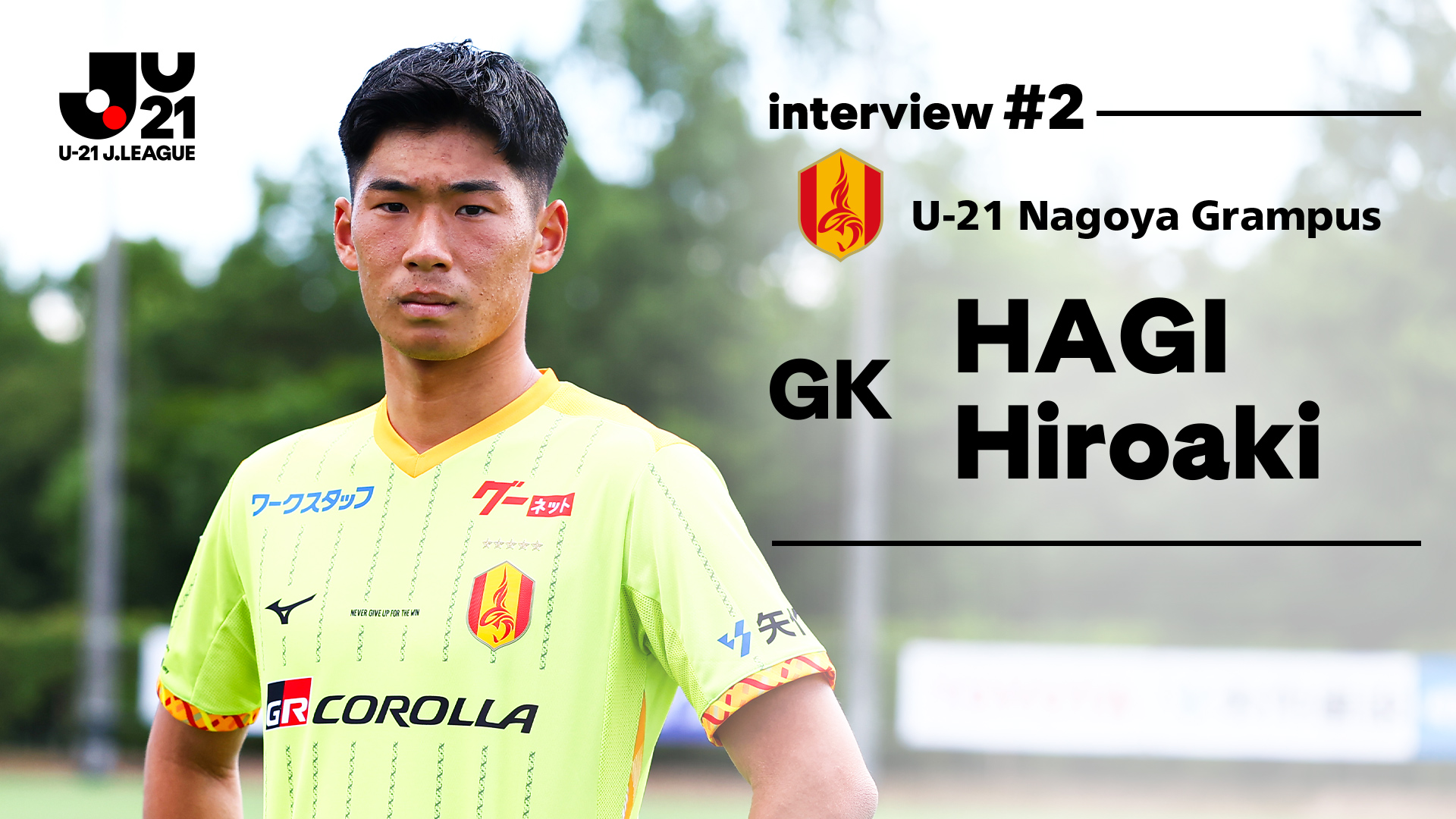
The U-21 J.League kicks off on 22 August. Newly established to accelerate the development of Japanese football and give young players a stage on which to challenge themselves, the league will bring together talent with the potential to represent Japan at senior level in the years ahead. In Poised to Pounce, we take a closer look at the careers and personalities of the next generation of players expected to make their mark. Part Two focuses on Nagoya Grampus’s ambitious young goalkeeper Hiroaki Hagi and the path that has brought him this far.
■ A path shaped by Kasugai, a hotbed of footballing talent
Hagi is the latest in a long line of quality goalkeepers to emerge from the Nagoya Grampus academy. Standing 189 centimetres tall, he combines an imposing frame with outstanding athleticism, reflected in his sharp reactions, ability to produce saves when they matter most and the distance he can generate with his long distribution.
The competition he stepped into after joining the first team in 2026 could hardly be tougher. Daniel Schmidt and Alexandre Kouto Horio Pisano have both represented Japan, while the vastly experienced Yohei Takeda remains a dependable presence alongside them. It is easy to understand why Hagi’s first reaction after joining the group was: “I honestly didn’t think I could compete with them.”
Yet the club’s decision to place a player straight out of high school in such a demanding environment also says plenty about how highly they rate him. There is added significance, too, in the fact that he is a local player from Aichi Prefecture. The newly launched U-21 J.League offers an invaluable stage on which to accelerate his development.
Hagi was born in Kasugai, just north of Nagoya. His introduction to football came almost by chance: the kindergarten he attended happened to have a football club. His parents simply wanted him to play some kind of sport, and Hagi says that if there had been a baseball team there instead, he would probably have ended up playing baseball.
As it happens, Kasugai is something of an under-the-radar hotbed of footballing talent in Aichi. Looking only at players with connections to Nagoya Grampus, Koki Sugimori, now with Tochigi SC, Haruya Fujii and the aforementioned Pisano all hail from the city. They all grew up close by, in neighbouring primary-school districts.
The area is also home to the well-established FC Fervor Aichi, while Aqua JFC, the club Hagi played for, has built a growing reputation of its own in recent years. Looking back, Hagi’s path into football seems almost inevitable. Add in the fact that his parents and brother played the game too, and perhaps it really was fate.
■ The setback that made him decide: ‘I’m going all-in on goalkeeping’
Hagi was already more than 130 centimetres tall in his first year of primary school and initially made use of that size as a forward and defender. Daichi Suzuki, now with Sagan Tosu, later joined the club, and Hagi remembers the two regularly switching roles.
“When Daichi played further forward, I’d play at the back, and sometimes it was the other way round. We used to alternate like that. I played on the right side of midfield as well. I was bigger than everyone else, so I never lost in the air. I actually scored quite a lot of goals.”
The smile on his face as he recalls his days as an outfield player says everything about how much he enjoyed them.
So how did a player who enjoyed scoring goals end up between the posts? The team suddenly found itself without a goalkeeper after players moved away or stopped playing football, and Hagi, as the tallest member of the side, was the obvious candidate to step in. But circumstance alone would not have been enough to make goalkeeping the passion that eventually carried him into the professional game.
The real turning point came soon after his move into goal, when Hagi was in his fifth year of primary school and failed to make the Aichi Prefecture Training Centre squad.
“When I first became a goalkeeper, Nara-san [Seigo Narazaki, now goalkeeper coach] was still playing. I’d watch him and think goalkeeping looked fun. I thought I might as well give it a try, but at first I wasn’t thinking about taking it seriously. Then, in my fifth year of primary school, I had my first real setback as a goalkeeper. Everything had gone smoothly until then, but I didn’t get through the selection for the prefectural training centre. I was angry. I was thinking, ‘Why didn’t I get in?’ and felt there were players being selected who weren’t as good as me. When I asked why I hadn’t been picked, they basically told me, ‘We don’t know how much taller you’re going to get,’ and ‘You don’t have the technique.’”
What frustrated him even more was the goalkeeper selected ahead of him.
“There was another player who, like me, had developed early and was tall — actually taller than I was at the time. But he seemed a little afraid of the ball, so I remember thinking, ‘Why him and not me?’ That was when things really started. I started going to both the Grampus goalkeeping school and another one in Nagoya. At the other school, we mainly worked on the basics, while at Grampus I practised techniques such as diving. Once I started properly working on my goalkeeping technique, I was selected for the prefectural training centre later that year.”
That initial rejection changed his outlook completely.
“That setback made me think, ‘Right, I’m going all-in on being a goalkeeper.’ It was the first time I genuinely thought, ‘I want to get better.’ I never thought about going back to being an outfield player just because I hadn’t been selected. Part of that was because we didn’t have another goalkeeper in the team, but I think my competitive side came out as well. When I wasn’t selected, I just thought, ‘I’ll make it next time.’ I didn’t want to run away from it either. Looking back, if that hadn’t happened, I don’t know whether I would ever have made it into Grampus.”
Any doubts about whether his early height advantage would last soon faded. By the end of his sixth year of primary school, he had grown to 164 centimetres. He also began collecting silverware, including the Fujipan Cup, one of Aichi’s traditional youth competitions, and before the summer he had already secured a place with Nagoya Grampus U-15.
There was another memorable moment at the Fujipan Cup. Despite being the goalkeeper, Hagi scored. “I was going for goal, thinking that if someone got a touch on it, there was a chance it might go in.” The ball had been launched from near his own goal and travelled all the way in. Hagi still sounds disappointed that his name was never announced as the scorer, but the story offers an early glimpse of a quality that remains one of his weapons today: the distance he can generate with his long kicking.
At the Aichi Prefecture Training Centre, Hagi trained alongside Haruki Goto, who later joined Shimizu S-Pulse Youth and went on to Chuo Gakuin University, as well as Ryota Hirano, who progressed from Oita Trinita U-18 to Kansai University. He also took part in programmes including the JFA Football Future Program. It was there that he met a number of players who would later become his team-mates at Nagoya U-15 and U-18. Buoyed by those experiences, Hagi was ready to take the next step with one of Aichi’s leading academies.
■ The silver lining to injury: growing 20 centimetres during rehab
“At first I was worried about whether I could cope at this level, but little by little I got used to it and started thinking, ‘Actually, I can do this.’ I’m glad I was able to put myself in an environment where I could improve.”
Hagi began his junior-high years full of enthusiasm, but injuries would occupy almost half of his time at U-15 level. Soon after he joined Grampus, the COVID-19 pandemic struck, leaving the team unable to play matches with any regularity.
Just as the pandemic began to ease, Hagi fractured his hand. That autumn came a stress fracture in his foot. In his second year, he suffered a serious shoulder labral injury; once that had healed, another stress fracture followed. There were days when he made the roughly 40-minute journey from home to the training ground purely for rehabilitation and found himself thinking, “I really don’t want to go.”
There was, however, one unexpected upside to all that time spent recovering: Hagi shot up in height.
Having been 164 centimetres when he entered junior high school, he had grown to 184 centimetres by his third year. Daiki Mitsui, now with Tokushima Vortis, and Taika Nakashima of Thespa Gunma — both formerly of Nagoya — have spoken passionately about the connection between rest, sleep and height, insisting that “if you sleep a lot, you grow”. Even while his body was recovering from injury, Hagi somehow managed to add 20 centimetres to his frame, underlining the remarkable physical gifts he possessed.
“If you look at it positively, there were definitely some good things to come out of that period. From my first year of junior high school, I was able to play with the age group above me in the Club Youth Championship and the Takamado Trophy. Then I played in those competitions with my own age group as well, and we made it as far as the semi-finals. So, it was also a period when I gained a lot of good experience.”
Despite the injuries, Hagi could look back on those three years as a valuable period of development before earning promotion to Nagoya U-18.
■ Narazaki’s philosophy lives on: ‘a goalkeeper who wins games for his team’
Hagi was already getting opportunities in the Premier League WEST in his first year with the U-18s, yet he admits there was a time when he wondered whether to take a different route.
“The All Japan High School Soccer Tournament was a big stage I wanted to experience.”
Like so many young footballers in Japan, Hagi was drawn to the prestigious national high school championship. Having already experienced national competition at junior-high level, joining a high-school side that played in the Premier League was a genuine option. Among the school teams competing in the league at the time were Maebashi Ikuei High School and Ryutsu Keizai University Kashiwa High School in the EAST, and Ozu High School and Riseisha High School in the WEST.
Ultimately, however, he chose Nagoya U-18. The decisive factor was the environment — in more ways than one.
“I know I have a bit of a tendency to slack off. At a high school, because it’s a school club, it can be easier to drift away from football or get distracted by other things. But at a club academy, if you do that, you’re quickly left behind. My team-mates were all highly motivated, and being in an environment where everyone wanted to become a professional really pushed me. There were older players who were already close to turning professional too, and that was another source of motivation.”
Even when he was in junior high school, Hagi would say, “I want to become a professional one day!” But he admits the words were not yet backed by genuine conviction.
“I wasn’t saying it because I actually thought I could become one. It didn’t feel realistic. I thought I probably wouldn’t make it, that I’d go to university and maybe end up giving up football there.”
That admission somehow feels entirely in character for Hagi. Away from the pitch, he is quiet and unassuming, with a certain innocent quality about him. Ask him how much he developed over his three years at junior high school, and even he begins to sound unsure.
“I felt as though my technique improved naturally as I got older, but I don’t really know how other people saw me. Even as I got taller, I didn’t lose the reactions I already had, so the area I was able to cover got bigger. That counts as improvement... right?”
Hagi, it turns out, does not remember the past particularly well.
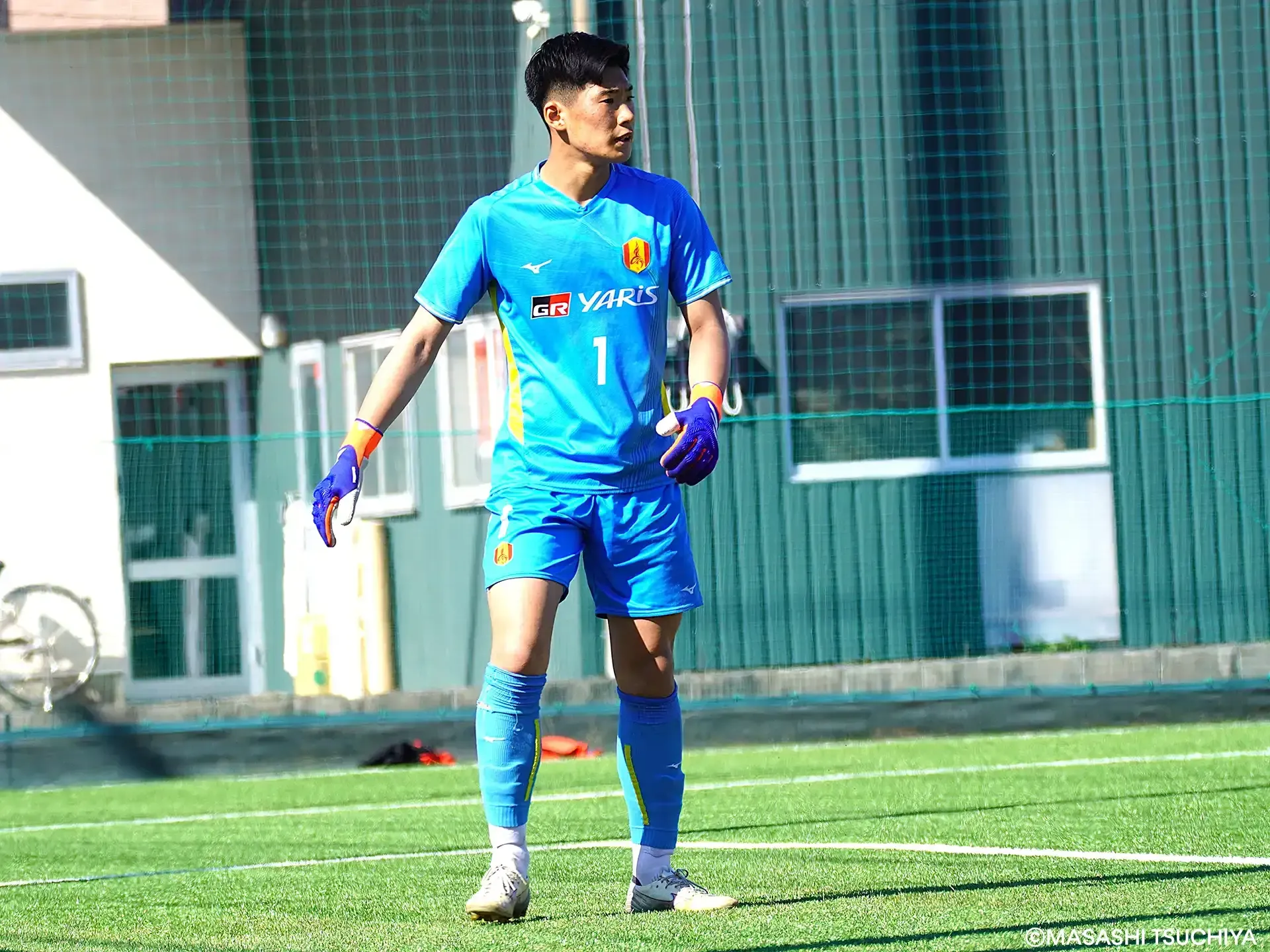
What is beyond doubt is that he continued to develop as a footballer. Injuries remained a recurring issue during his high-school years, but in his second year he set himself the goal of being selected for a Japan youth national team — and followed through on it. His performances in the Premier League improved year by year after he established himself in the starting line-up in his first year. Over time, he grew into a goalkeeper worthy of Nagoya’s tradition, embodying Seigo Narazaki’s philosophy of “a goalkeeper who wins games for his team”.
Hagi had barely watched football matches or individual highlight reels before high school. As he got older, though, he began studying them more regularly, both to establish his own style and to find role models who suited him.
“Personality-wise, I get fired up very quickly. Put another way, I’m quite a bold goalkeeper. I thought there might be more overseas players with that sort of style, so I started watching clips of goalkeepers from abroad. Aaron Ramsdale and Kepa Arrizabalaga, for example, make a lot of really bold plays, so I watch their highlights quite often.”
Learning to look at himself more objectively and use that self-awareness to improve was a major change. He also began to see his fiery side differently. Until junior high school, Hagi admits he let results affect him too much. When the team lost, he would get angry and sometimes bring the mood of the group down with him.
■ The challenge of becoming ‘someone who simply stops shots’
Motohiro Yamaguchi, then the academy director, offered a slightly different perspective when Hagi’s promotion to the first team was announced.
“I actually think that emotional side can be a strength. There are quite a lot of young players who are the opposite and don’t show much emotion at all. So, I don’t think we should be too negative about it.”
Hagi’s fire, in other words, was also one of his strengths. It left him with two contrasting sides: fiery and expressive on the pitch, quiet and mild-mannered off it.
“I knew I needed to control my emotions, but I never really felt I had to change that side of myself. I thought it would be wrong to stop speaking up altogether. I started thinking, ‘It’s a match — surely it’s fine to say this much.’ Away from football, at school for example, I don’t have those kinds of emotional swings. If anything, I’m pretty quiet. If I’m with someone I can joke around with, I’ll mess about, but when I’m on my own I hardly ever get angry. So, football is really the one place where I feel I don’t have to keep my emotions in check.”
“When it’s a game, that desire to win comes out. I hate losing, so I naturally get fired up. If anything, I get more nervous before the match. Once I start feeling nervous, it can get really bad — to the point where I feel like I’m going to be sick. That’s tough, so when I was in the youth team, I’d sometimes take it easy in the warm-up. Once the game starts, though, the nerves disappear. Maybe that’s when the switch flips for me.”
More recently, Hagi has also been trying to bring greater composure to his game.
“Lately I’ve started thinking it would be good to play with a bit more composure and make calmer decisions, and that’s something I want to work on. But it’s difficult. It isn’t something I’ve done before, so I’m not going to be able to do it straight away. Playing on instinct comes more naturally to me, but sometimes that isn’t enough to cope with the intensity of professional football. So, I know there are times when I need to stay calmer and make better decisions.”
Hagi himself knows that simply carrying on as before will not be enough. He wants to understand his own style, work on controlling the emotions that have sometimes been an issue and continue developing — without losing the qualities that make him who he is.
For six years in the Nagoya academy, he trained day after day under former Grampus goalkeeper and academy coach Koichi Hirono. Now, working under Seigo Narazaki in the first team has brought a new dimension to his development.
“I’ve been told plenty of times, ‘This isn’t youth football anymore.’ I have to understand that this is my profession now and give absolutely everything to it.”
Narazaki’s goalkeeping philosophy is, in many ways, as orthodox as it gets.
“He tells me again and again, ‘It’s important to pay attention to every single detail.’ I do sometimes forget to do that.” [laughs] “But I’m trying to be as meticulous as I can.”
When Hagi watched Narazaki from the stands as a primary-school pupil, his first impression was rather different.
“I used to think, ‘He looks scary — really intimidating.’” [laughs] “But then this intimidating-looking guy would stop absolutely everything, so I remember thinking, ‘The player taking the shot must be scared of him too.’”
Today, being coached by the very player he once watched with such awe is a source of real pride. And so, Hagi keeps training, day after day, in pursuit of the image that stayed with him from childhood: someone who simply stops shots.
■ Aiming to surpass his mentor — taking on fierce competition head-on
Hagi also has his sights firmly set on Nagoya’s goalkeeper position, where the competition is among the fiercest anywhere in the J.League. The rivals in front of him are formidable, but the respect he has for them only fuels his competitive instincts and makes him want to challenge them head-on.
“When I first joined this group... I honestly couldn’t see how I was going to compete with them. I remember thinking, ‘Can I really play alongside these guys?’ I was almost overwhelmed before I’d even got started. But training is fun, and Takeda-san and the others keep the atmosphere lively. The bar feels incredibly high, but I’m enjoying the challenge. I don’t think there are many teams in the J.League with this much quality and depth in goalkeeping.”
“At first, all I felt was anxiety. Obviously I was happy to be promoted, but then there was Takeda-san, this hugely experienced goalkeeper. There was Dan-kun, who had played abroad for years and had been with the Japan national team. And then there was Pisano-kun, who had only recently started playing regularly and had already made it all the way to the senior national team. You don’t see a group like that very often. But once you actually work alongside them, you start seeing all sorts of things. There’s so much I can learn from them, and it’s incredibly valuable for me. Now I see the chance to train with them as a really good opportunity.”
Words from former general manager Motohiro Yamaguchi have also stayed with him.
“I was really happy when Yamaguchi-san told me, ‘Not everything is going to fall into place straight away, but if you keep improving steadily, you’ll be all right. I believe you’ve got what it takes.’ I wouldn’t say I’m simply waiting for my turn, but right now my goal is to gain experience here, sharpen my technique and keep working steadily so that I’m ready whenever my chance comes. I want to build the confidence and mentality to come in and perform whenever I’m called upon, like Takeda-san does.”
Whenever Hagi has faced an obstacle, his response has always been the same: “I don’t want to lose” and “I don’t want to run away.” Each time, he has grown — sometimes literally — and found a way through.
When Hagi’s promotion to the first team was confirmed, he was asked about his ambitions for the future. His answer was a bold one.
“I want to surpass Narazaki-san’s number of J1 appearances.” His career total is 631.
Only three players have ever made more than 600 J1 appearances. It may have been an ambitious target, but it was also a refreshing statement of his determination.
With the J.League’s one-off 2026 Special Season now over, Hagi’s professional career begins in earnest.
Hagi is equally motivated by the arrival of the U-21 J.League.
“Until now, it has been difficult for young players to earn playing time in the J.League, especially goalkeepers. But now that we can play in the U-21 J.League, I think it will help us maintain our match sharpness. And if I perform well there, I could earn a chance with the first team in the J.League. I want to approach every game in the U-21 J.League determined to win.”
It bears repeating: at Nagoya, the ideal is “a goalkeeper who wins games for his team”. Hiroaki Hagi is the latest young goalkeeper to carry on that tradition. With his trademark passion between the posts, he aims to make the saves that rescue his team and lead them to victory.
Interview and text by Yuichiro Imai
