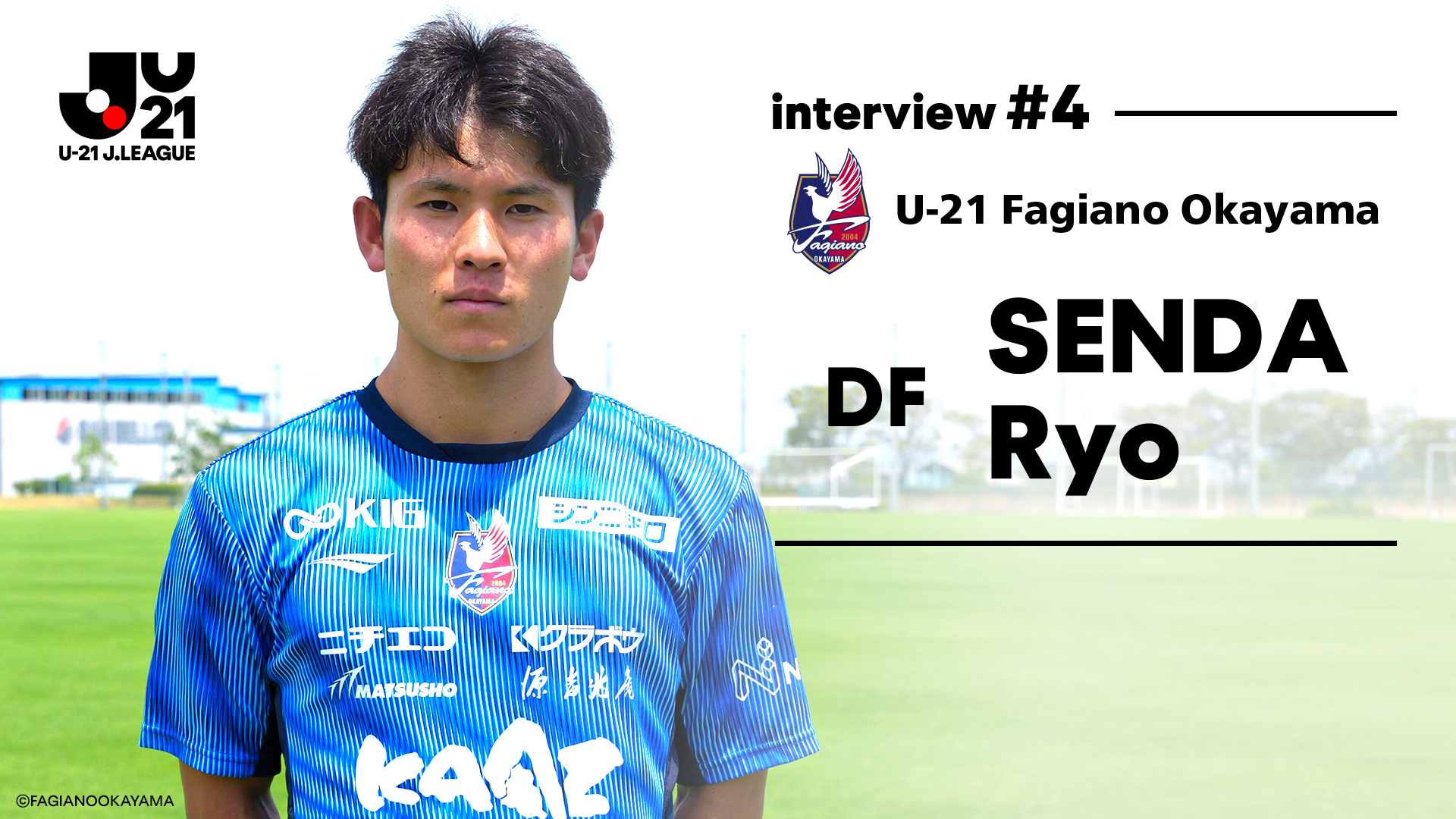
The U-21 J.League kicks off on 22 August. Newly established to accelerate the development of Japanese football and give young players a stage on which to challenge themselves, the league will bring together talent with the potential to represent Japan at senior level in the years ahead. In *Poised to Pounce*, we take a closer look at the careers and personalities of the next generation of players expected to make their mark. Part Four follows the journey of Fagiano Okayama full-back Ryo Senda, who was born and raised in Okayama.
■ ‘You’re going to break the wall’: how his mother got him into football
Born and raised in Okayama, Senda has long held one thought close to his heart. The club’s philosophy, “Dreams for Children!”, has been carefully nurtured by everyone connected with Fagiano. For Senda, stepping onto a J.League pitch himself — and making an impact there — would be one of the clearest ways to carry that philosophy forward.
“I think Fagiano Okayama’s philosophy of ‘Dreams for Children!’ is wonderful. If young players like us get to play in matches, I think it makes that idea more real and can inspire children to think, ‘I want to work even harder at football.’ So, I want to get on the pitch as soon as possible and help carry the club’s philosophy forward.”
As a local player, Senda carries considerable expectations from Fagiano supporters. The young full-back has admired the club’s home stadium since childhood and continues to wait for his chance, believing that one day his own play will bring those stands to life.
The decision that got him into organised football came from his mother, who had her hands full with a mischievous young Senda.
“I used to kick a ball against the wall in our garden all the time, and eventually my mum said, ‘You’re going to break the wall, so please go and play football.’” [laughs] “One of her friends introduced us to a club, and I ended up joining it.”
That club was J-Field Okayama FC. Senda started at its football school, then joined the team in his first year of primary school and became increasingly absorbed in the game.
“J-Field Okayama FC really valued technique, and a lot of what I learned there still forms the foundation of my game. We did a lot of basic work — dribbling around cones, passing drills and things like that — and I think that training still shows in the way I play now.”
Even as a primary school boy, Senda was already looking up to Fagiano’s players. Whenever he had the chance, he would go to City Light Stadium, sometimes week after week, to watch them from the stands.
“I always thought it was brilliant — and really cool — to have a J.League club in my hometown. Lee Yong-jae was scoring all the time, and there were players like Hayato Nakama, Kota Ueda and Kenji Sekido. There are too many to name, really, but the players who were leading Fagiano when I was watching them back then have really stayed with me.”
■ Passing the trial and joining Fagiano Okayama U-15
As he prepared to enter junior high school, Senda had the option of staying with J-Field Okayama FC at junior-youth level. But he wanted a change of environment and decided to try out for Fagiano Okayama U-15.
“I remember being nervous, but for some reason I had this strange confidence that I’d get in.”
That confidence proved justified, and he earned a place. One of the most influential coaches during his U-15 years was Kimiaki Saruta, now manager of Fagiano Okayama U-15 Masada. Senda regards him as one of the mentors who taught him how to approach the mental side of football.
“Saruta-san really valued technique, but he also helped make me stronger mentally and brought out that inner drive in me. That still has a huge influence on me now. He was a type of coach I hadn’t really come across before.”
By his second year, Senda had established himself in the side while playing alongside boys a year older. In his third year, he also showed a knack for delivering on the national stage. At the Club Youth Championship, he scored an equaliser against Internacional in the second group-stage match, then struck another dramatic late leveller against Urawa Reds Junior Youth when a draw was enough to send Okayama through. Two goals in successive matches at a national tournament offered an early glimpse of his ability to deliver under pressure.
The run ended in the first knockout round with a 3-0 defeat to FC Tokyo U-15 Musashi, a side featuring four players who would later earn promotion to FC Tokyo’s first team. It is a match Senda still remembers clearly.
“We actually had more clear-cut chances, but we missed them and ended up conceding three, so that one was really frustrating. I felt there was still a gap in quality, and we didn’t get many opportunities to play teams from Kanto, so it was a huge experience for me.”
■ A club first: U-18 Premier League promotion — and the senior who came running towards him
Senda progressed to Fagiano Okayama U-18, but with both the level around him and his environment changing significantly, he struggled to stay healthy through the summer of his first year.
“About once a month, I’d come down with a fever and end up missing around a week of training. I think my fitness just couldn’t keep up at the time.”
His condition gradually improved, and he made the squad for that summer’s Club Youth Championship as Okayama produced an impressive run to the semi-finals. Senda did not play many minutes, but the energy of the senior players and the growing sense of unity within the group left a lasting impression on him.
“That tournament was a huge inspiration for me. The togetherness was incredible. It didn’t matter whether someone was playing or not — the whole team was genuinely united, and I think that’s why we were able to go so far. I have nothing but respect for the third-year players from that team.”
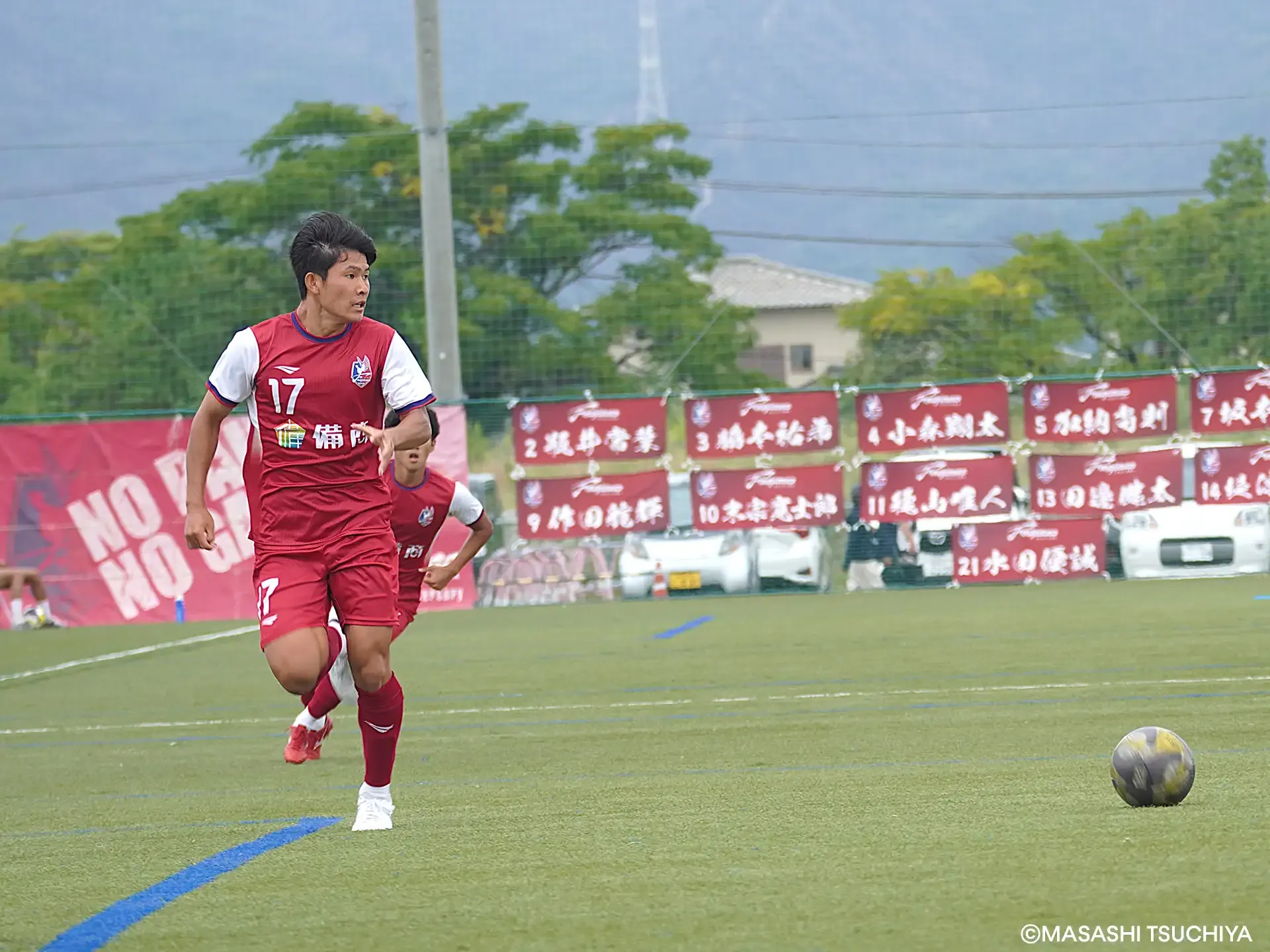
The year-end play-offs for promotion to the U-18 Premier League became the most memorable competition of Senda’s three years with the U-18s. After beating Hokkaido Consadole Sapporo U-18 in their opening match, Okayama faced Kyoto Sanga F.C. U-18 in the second round. Still only a first-year player, Senda was named in the starting line-up for both matches.
“It was a match where it really was just win or lose, but I felt more like, ‘Right, let’s do this,’ than nervous. I was also thinking about the older players who couldn’t play or hadn’t made the squad, and I wanted to fight for them too.”
Okayama had also faced Kyoto in the group stage of that summer’s Club Youth Championship and been well beaten. Losing to the same opponents twice was not an option. Despite being outshot by almost four to one, Okayama secured a 1-0 victory to seal promotion to the U-18 Premier League. At the final whistle, Senda suddenly saw someone running towards him.
“Yuho Tahara, who was a year above me and played in the same position, came straight over as soon as the match ended. I remember us giving each other this huge hug. That was when all the emotion came flooding out.”
A victory filled with smiles and tears had opened the door to a new chapter in the club’s history. For Senda, it remains one of his most treasured memories. The U-18 Premier League was new territory for both Okayama and Senda, and week after week they faced some of the strongest sides in youth football. Over the course of the season, both the team’s identity and Senda’s own sense of where he stood began to take clearer shape.
“Once we actually started playing in the league, both as a team and individually, we felt there wasn’t that much of a gap. But there were so many games where we thought, ‘If only we’d scored one more,’ or ‘If only we’d kept one more out.’ It made me realise just how difficult it is to see a match through and win.”
“I played a lot at centre-back and full-back, and every team had a top-class forward. Going up against them gave me a chance to test myself and see what I was still lacking. I spent the whole year thinking, ‘The Premier League is great. This is fun.’ I really enjoyed it.”
■ A first youth international call-up — and a first-team camp full of inspiration
That September, head coach Kyu Sa Ryang, now a coach at Shonan Bellmare, suddenly delivered some unexpected news: Senda had been called up to the U-17 Japan National Team for The 26th International Youth Soccer in Niigata. It was his first selection for a national age-group side, and the surprise left him with a strange feeling he had never experienced before.
“Coach Ryang suddenly broke the news before training. I hadn’t expected to be selected for the national team at all, and I remember the ball just wouldn’t do what I wanted in training that day. Maybe it was nerves...”
Pulling on a shirt bearing the Japanese flag left a deep impression on the 16-year-old and gave real meaning to the idea of representing his country.
“When you actually sing the national anthem before a match, it fires you up even more. As long as I’m playing football, I think the national team is a special place that I always need to keep striving for.”
Senda marked his first call-up with a strong showing, including an assist in the opening match against Peru, and soon became a regular presence in Japan’s youth national-team set-up.
Okayama U-18, meanwhile, battled their way to survival in the U-18 Premier League. Early in the new year, the club announced that Senda and Kanshiro Suemune would be registered with the first team as Type 2 players. The announcement also contained a notable detail: both had already been training with the senior squad since the first session on 9 January, making them the first academy players in club history to take part in first-team activities on a full-time basis from the start of a season. Senda was deeply grateful for the opportunity and determined to make the most of it.
“Around the end of my second year, I was told, ‘Next year, you’ll be with the first team from the start.’ I felt like there must be something they expected from us, so I was nervous, but I also thought, ‘I’m the youngest here. I just need to go for it.’”
Once inside the first-team environment, the physical difference was obvious. What struck Senda even more, however, was how clearly the senior players understood the purpose of every exercise — and how consistently they trained with real match situations in mind.
“Every player was so good at understanding what each drill was for. You could feel how much thought went into every pass and the intention behind it. Even in a normal passing drill, they were always picturing a match. I realised I wasn’t thinking that way enough, and that really struck me.”
One centre-back, more than a decade his senior, made a particularly strong impression.
“Daichi Tagami was doing everything — build-up play, defending, communication — at such a high level. I went over and spoke to him at camp, and he told me he used to be a forward. When I heard that, it made sense. I thought, ‘That’s why he plays like someone who understands exactly what forwards don’t like.’”
■ Premier League survival in his team-mates’ hands — and deep gratitude for the academy
Senda’s promotion to the first team was announced in February. Throughout his third year of high school, he generally trained with the senior squad during the week before returning to the U-18s at weekends for competitive matches, mainly in the U-18 Premier League. He is acutely aware of the advantage that year has given him.
“At first, my level just wasn’t there at all. I really struggled and it took me a long time to adjust. But because I got to spend a whole year training in a professional environment ahead of time, I now understand clearly what kind of football the manager wants to play and what’s expected of me. I can push my body harder now as well. That extra year of experience has been huge.”
Towards the end of the Premier League season, Okayama U-18 found themselves on the brink. With two matches remaining, they had dropped to 11th and into the automatic relegation places. Next came a home six-pointer against bottom side Higashi Fukuoka High School, just one point behind them. Senda went into the 90 minutes fully aware of what was at stake.
“We really had no room left for error. As third-years, we were absolutely determined not to be relegated from the Premier League in our final season, and it was important for the club to stay in the league for as long as possible too. We were unbelievably fired up for that game.”
Senda opened the scoring in the 18th minute before fellow third-years Kenta Tanabe, now at Kansai University, and Ryotaro Tsutsumi, now at Kwansei Gakuin University, added further goals in a 3-0 victory. Shizuoka Gakuen High School, who had begun the round in 10th, lost their match, allowing Okayama to climb out of the relegation zone ahead of the final day.
The decisive final match was away to Kamimura Gakuen High School. But Senda’s name was nowhere to be found on the match sheet. “Well... I had the flu at the time,” he explains. The unexpected illness left him at home, waiting for good news from his team-mates.
“My parents were sending me updates on LINE, but it felt like all I was getting were notifications that we’d conceded again. All I could do was keep checking Shizuoka Gakuen’s result and pray. I felt so useless...”
Okayama were beaten 7-0, but Shizuoka Gakuen could only draw, meaning Senda’s side survived. “I was so relieved. Even now, the coaches never stop teasing me about missing that match.” [laughs] What was once an agonising afternoon has become another cherished memory he can now look back on with a smile.
Ryang, who coached Senda for three years, taught him exactly what he needed to know as a footballer.
“Coach Ryang loves football more than anyone. Whether it was a small-sided game or even a juggling contest, he was incredibly passionate about winning. The way he approached football and the values he taught me have definitely shaped who I am now. He had a huge influence on me.”
Senda can say with confidence that his irreplaceable years in Fagiano Okayama’s academy helped shape the player he is today.
■ Three months in Brazil: ‘It changed the way I think about football’
For three months from February of his rookie year, Senda travelled to Brazil with Kanshiro Suemune for a short-term training stint at Maringá FC. With no interpreter, he spent three intense months focused on football and on his own development.
“Those three months completely changed the way I think about football. Maringá are probably around the size of a J3 club in Japan. When I spoke to the players, I learned that some of them had really complicated family situations, and some were sending almost all of their monthly wages home to their parents. It really hit me that they were training with their livelihoods on the line.”
Senda only learned he was going to Brazil about a week before departure. With almost no time to prepare, he relied heavily on his phone as he tried to communicate in Portuguese. Little by little, though, he made close friends — enough that he felt a touch of sadness when it was time to return home.
“It was the first time I’d ever had friends overseas, so I hope I can see them again somewhere. I was sad when it was time to leave. When Japan played Brazil at the World Cup, they messaged me, and because Brazil won, they gave me loads of stick.” [laughs] “But things like that are fun too.”
As long as they remain involved in football, perhaps their paths will cross again. And if that reunion should one day come on the pitch — one wearing blue and the other Brazil’s canary yellow — it would be difficult to imagine a better way to meet again.
With the U-21 J.League also beginning in August, the 18-year-old is clear-eyed about where he stands and the steps he now needs to take.
“My first priority is playing in the J.League, but having the U-21 J.League as another place where I can show what I can do is huge, and I’m really grateful for it. If I get to play there, the first-team staff will be watching too, so I want to make a strong impression and use it to help move my career forward.”
“Beyond that, my immediate goal is to make my J.League debut as soon as possible. Right now, one of my biggest targets is to play as many minutes as I can in J.League matches. Longer term, I want to win a place in the starting line-up and eventually become a player who gets selected for Japan.”
Senda knows as well as anyone the value of having a J.League club in his hometown. Brighter days lie ahead. Poised to pounce, Fagiano Okayama’s No. 31 now hopes to make his mark on the same pitch he once watched from the stands — and inspire the next generation of children in Okayama to believe that they, too, can one day follow the same path.
Interview and text by Masashi Tsuchiya
