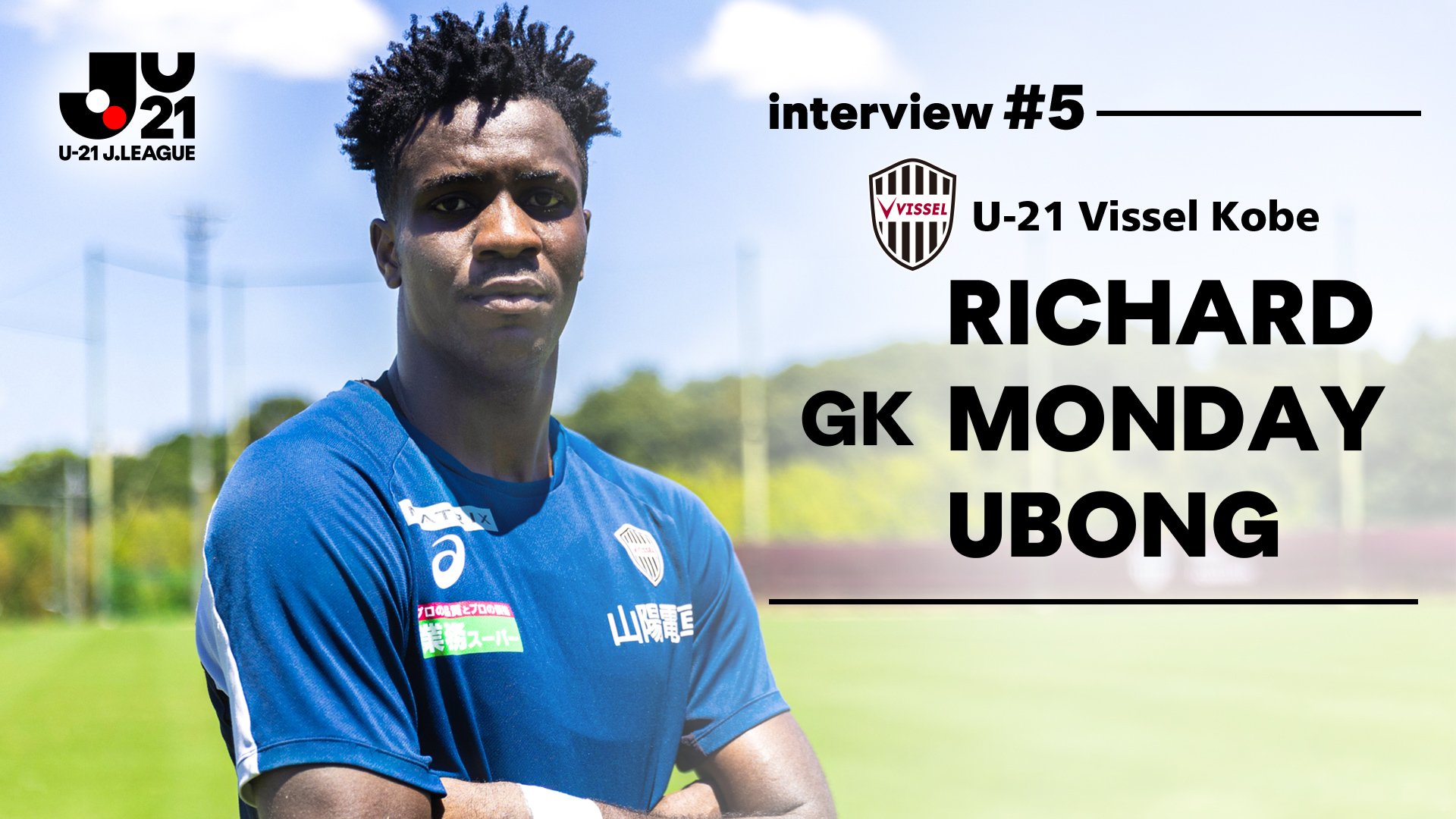
The U-21 J.League kicks off on 22 August. Newly established to accelerate the development of Japanese football and give young players a stage on which to challenge themselves, the league will bring together talent with the potential to represent Japan at senior level in the years ahead. In Poised to Pounce, we take a closer look at the careers and personalities of the next generation of players expected to make their mark. Part Five focuses on 20-year-old Vissel Kobe goalkeeper Richard Monday Ubong and his efforts to forge a career far from home.
■ Winning everyone over with his Kansai dialect and cheerful personality
At Vissel Kobe’s new-season press conference in January 2025, goalkeeper Richard Monday Ubong, newly arrived from Fukuchiyama Seibi High School in Kyoto, quickly won over the club’s fans and supporters with his personality.
“I’m really grateful to everyone who has given me this opportunity. Please call me Richard. Richie is my nickname, but to start with, just call me Richard.”
His strong Kansai dialect drew a burst of laughter from the room. An interpreter sat alongside him for the media interviews afterwards, but every now and then a phrase in Kansai dialect slipped out and lightened the mood.
“I’ve got lots of friends from Kansai, so I use Kansai dialect a lot too. I picked it up in high school.”
At 194 centimetres and 84 kilograms, Richard is a goalkeeper known for his handling of high balls and crosses, as well as his shot-stopping, making full use of his imposing frame and long limbs. Yet despite being the tallest of Vissel’s goalkeepers, he was not especially big as a child. He also began his footballing life as a forward. After joining Iganmu Tiger FC in junior high school, he made his mark as a goalscorer, regularly finding the net with headers.
“My dad used to be a professional footballer. He never made the Nigeria national team, but he played centre-back. He was incredibly passionate about football — he was always talking about it. That’s how I got into football too. I started out in my primary school football team, then I was scouted by Iganmu Tiger FC when I entered junior high school. I was good at heading in crosses and was the second-highest scorer in the team. The top scorer was my childhood best friend David — Lawrence David, who now plays for Tokushima Vortis.”
Iganmu Tiger FC compete in the third tier of Nigerian football and have both a senior side and a U-17 team, with Richard playing for the latter. His turning point came at 14, when a sudden growth spurt led those around him to suggest a switch to goalkeeper.
“Even when I was a forward, I used to stay behind after training and watch the goalkeepers practise. Sometimes I’d play in goal for fun too. I think my dad and the coaches had seen that, but the main reason they suggested I change position was that I’d grown so much. My dad and the people at the club had really thought about my future before giving me that advice, so I decided to give it a go.”
■ Offers from Europe and Japan — and a move to Fukuchiyama Seibi High School
The switch quickly paid off. Richard began to stand out as a goalkeeper and, only a year after changing position, made competitive appearances for Iganmu Tiger FC’s senior side at the age of 15. His potential soon attracted the attention of professional clubs in Japan, Germany and Portugal, and offers followed.
“My goal for the future is to play for Nigeria, so I wanted to get to Europe as soon as possible. My dad thought Germany or Portugal would be fine too. But my mum was totally against it... She said no because we didn’t know anyone in Germany or Portugal and, at my age, she was still worried about how I’d live and what I’d eat.”
“Japan was the one place she was okay with because my dad had a friend living in Tokyo who could help me if anything happened. I had offers in Japan too, including from a J3 club, but I chose Fukuchiyama Seibi High School because part of the reason I wanted to go abroad was to study and learn the language. My parents also recommended going to a Japanese high school and playing for the school football team.”
Richard made the decision to study in Japan during the COVID-19 pandemic, however, and was unable to travel immediately. He finally arrived in the spring of 2022. From there began a new life of studying on the school’s International Course, living in a dormitory and playing football. At first, however, the language barrier and homesickness made the adjustment difficult.
“When I got there, I was shocked by how rural it was. The school was surrounded by rice fields and mountains, and almost everyone I saw around the neighbourhood seemed to be elderly.” [laughs] “It was completely different from Nigeria. I guess it was homesickness, but I was in a really bad mood all the time at first.” [laughs] “For the first year especially, I couldn’t understand Japanese at all and hardly anyone spoke English, so everything was difficult.”
“So even while I was at school, I was constantly on the phone with my family and friends back in Nigeria. There were nine or ten international students in my class, from places like Russia, the UK, China and Norway. They were all staying with Japanese host families, but I was the only one of us living in the boys’ dormitory. I felt lonely going back there every day.”
■ Learning Japanese through hard work — breaking down the language barrier
Things finally began to improve about a year after Richard arrived in Japan. An older player from back home had told him, “If you want to become a professional footballer, you have to be able to speak Japanese.” Richard took that advice to heart, spending around two hours every day studying Japanese one-to-one with a tutor.
Once he began to understand what people were saying, he felt much more at ease. As his spoken Japanese improved, communication with his friends became smoother and he began to enjoy going to school. The effect on his football was just as significant: as the language barrier came down, he found it easier to show what he could do on the pitch.
“When I couldn’t understand Japanese, we communicated in English, but for about the first year and a half there were times I made mistakes in matches because I couldn’t communicate properly with my team-mates. In practice matches, there were also times when poor instructions from me led to mistakes in the back line.”
“Even then, my team-mates learned English for me and would give me simple instructions like ‘right’, ‘left’ and ‘forward’ in English. My coach helped me a lot in different situations too, which I was really grateful for. But once I could speak a lot more Japanese, it was definitely easier. I could explain what I was thinking instead of just giving simple instructions, and from around the end of my second year, playing football became much easier.”
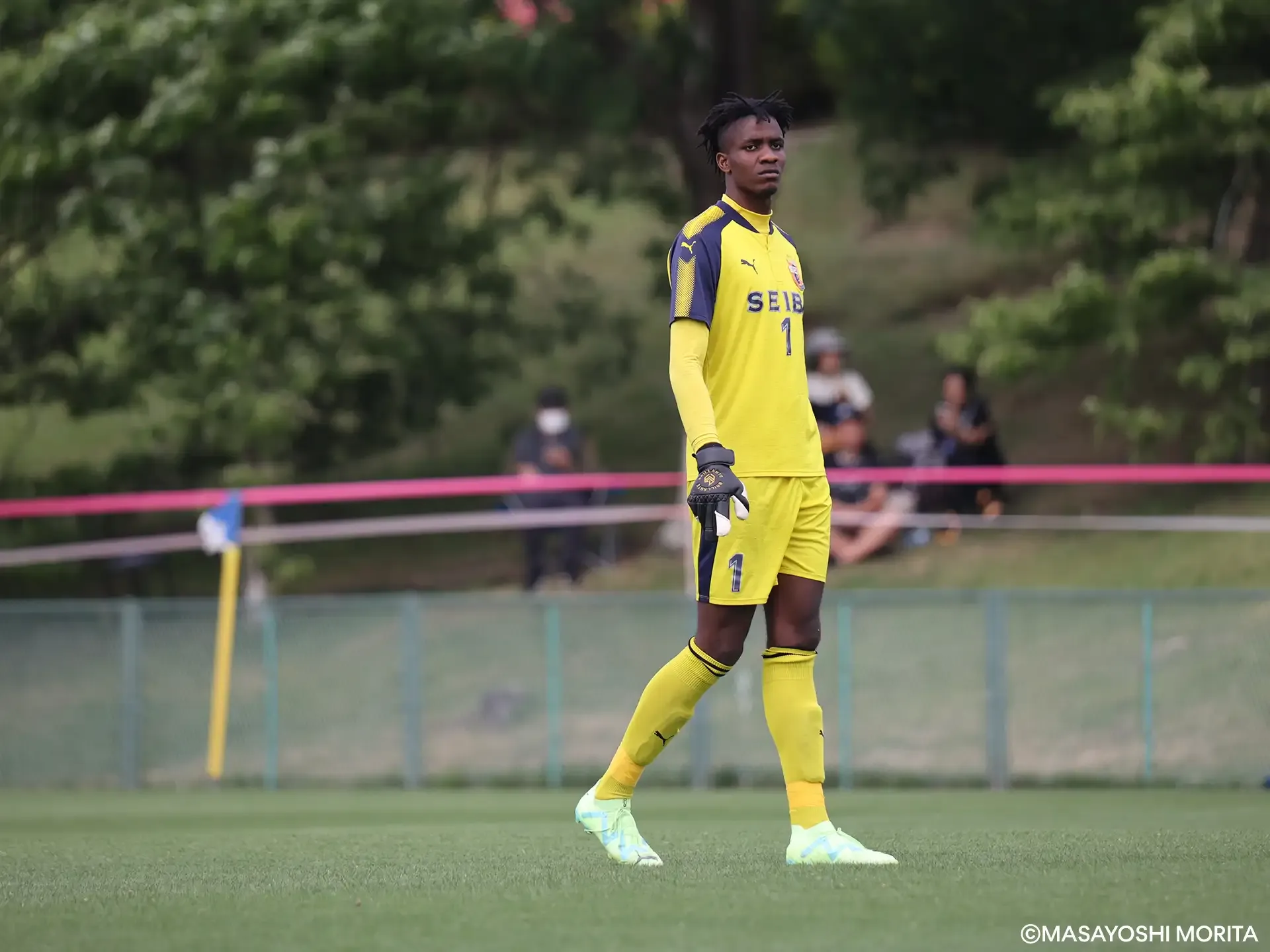
His time at Fukuchiyama Seibi was also important because it was there that Richard properly learned the fundamentals of goalkeeping. Being drilled in the basic techniques of the position clearly broadened what he could do as a shot-stopper.
“Every day after team training, my coach would spend around 45 minutes doing one-to-one goalkeeper work with me. At the time, I didn’t have much technique as a goalkeeper, and he was always telling me, ‘If you want to become a professional footballer, we need to sort out your technique.’ He taught me the basics of how to save and catch the ball, and after working on that for about six months, I started making more saves — and better ones too. My confidence grew a lot.”
■A shock in training — choosing Vissel to keep growing
Those positive experiences strengthened Richard’s desire to become a professional. But in his third year of high school, a training stint with Vissel Kobe made him realise, in his own words, that “I’m nowhere near good enough yet.”
Richard had already played for Iganmu Tiger FC’s senior side and faced plenty of shots from professional players, so he says the speed of shots from high-school players had never troubled him too much. Training with Vissel and coming up against seasoned J.League attackers was another matter entirely.
“Of course the speed of the shots was completely different from high school, but what surprised me most was the finishing technique of the attacking players. They were so good at outthinking goalkeepers and defenders, and their shooting wasn’t just powerful — they had so many different ways to finish. I was really nervous as well, but I couldn’t play anything like I wanted to. I went home in shock.”
That experience was precisely why Richard chose Vissel from the several offers he received when he graduated from high school. Training every day against Yuya Osako, Yoshinori Muto and Daiju Sasaki — some of the J.League’s most formidable attacking players — was exactly the kind of environment in which he believed he could improve.
“I trained with three or four other J1 and J2 clubs besides Vissel, but my high school coach told me, ‘Vissel are the strongest team in Japan right now. Wouldn’t it be better to challenge yourself at a higher level?’ My parents felt the same way, so I followed their advice.”
“To be honest, when I was in Nigeria, I only watched La Liga and Premier League matches, so I barely knew anything about the J.League... But Vissel were famous in Nigeria because Andrés Iniesta had played for them, and they were also competing in the AFC Champions League Elite. I thought this was a club that could bring me closer to the Nigeria national team.”
■ Learning every day from a top-class goalkeeping group
A year and a half into his professional career, Richard has yet to make a competitive appearance, but the experience has been every bit as stimulating as he had hoped. There is plenty to learn not only from Vissel’s attacking players, but also from the goalkeepers he competes with every day.
“Just as I expected, everyone is really good at football, and the level is so high. I also like how seriously the goalkeeping group approach every training session. Coach Matsumoto and Coach Tomii, as well as Shuichi Gonda, Shota Arai, Daiya Maekawa and Shioki Takayama, all bring something different, and there’s so much I can learn from them.”
“They’re always telling me, ‘Concentrate!’ and I’m genuinely grateful for that. On the pitch we’re all rivals and there’s a good edge to training, but off the pitch everyone is kind and they’re all really good people. There are some big names in the group, but everyone is very friendly regardless of age or experience. I’m always grateful to them.”
While continuing to polish existing strengths such as his build-up play and handling of high balls, Richard is also working to add new weapons to his game.
“I can already kick with both feet, but I don’t have the kind of kicking technique Daiya has, so that’s something I’m working on now. Up to now, I’ve used both feet about equally, but my left is better, so I want to use it a bit more — maybe 60-40 — and make it more of a weapon. I also want to keep improving through competitive matches, so I’m happy the U-21 J.League is starting.”
“I’ve been travelling with the squad in the AFC Champions League Elite over the past six months, and we’ve also played practice matches almost every week as the U-21 side. But I want experience in competitive matches, where there’s a different kind of pressure. If an outfield player makes a mistake, someone behind them can cover. But if a goalkeeper makes a mistake, it can lead directly to a goal, so you simply can’t afford it. I think playing under that kind of pressure will help me improve faster.”
■ ‘I definitely want to play for Nigeria by the time I’m 23’
Richard’s goalkeeping role model is Manuel Neuer, who featured for Germany at the recent World Cup.
“What amazes me is how relaxed he looks in every match, almost as if he were just training.”
Richard admires not only Neuer’s quality in build-up play, but also the way he anticipates every situation and is always perfectly set for a shot, no matter where it comes from. To him, Neuer possesses the complete range of skills a goalkeeper needs, from his ability with the ball at his feet to his shot-stopping and command of high balls.
“If I had to pick an outfield player, I like Cristiano Ronaldo. Whatever the match, he keeps working hard and reacting quickly to every situation, with that never-give-up mentality. I really respect that. I want his heart. I want that mentality too.”
Perhaps that is no surprise. Asked for his motto as a professional footballer, Richard replies: “Do your best & Never give up.” That is what it will take to achieve another clear target: playing for Nigeria by the age of 23.
“Honestly, I know I’m still a long way from the national team. I’m young, I don’t have much experience, and nobody knows who I am. I think a lot of people have never seen me play. But I’m going to keep working, and I definitely want to be in the Nigeria national team by the time I’m 23. By then, I should have the technique, skills and mentality I need as a goalkeeper, and I want to turn that into performances and reach my goal. So, I just have to keep working and working. I still want to get better and stronger.”
There is another goal behind that determination: bringing his family in Nigeria to Japan with the win bonuses he hopes to earn. Since his father died in 2024, Richard also feels a responsibility to become the main provider for his family.
“My mum and my four siblings are all looking forward to seeing me succeed, so I definitely want to bring them here. I want to show them Japan. But a return ticket costs about ¥320,000 per person, so for five people it’s not easy. Once I’m doing well with the first team and earning win bonuses, I’ll definitely bring them over. That’s another reason I’m going to keep working really hard.”
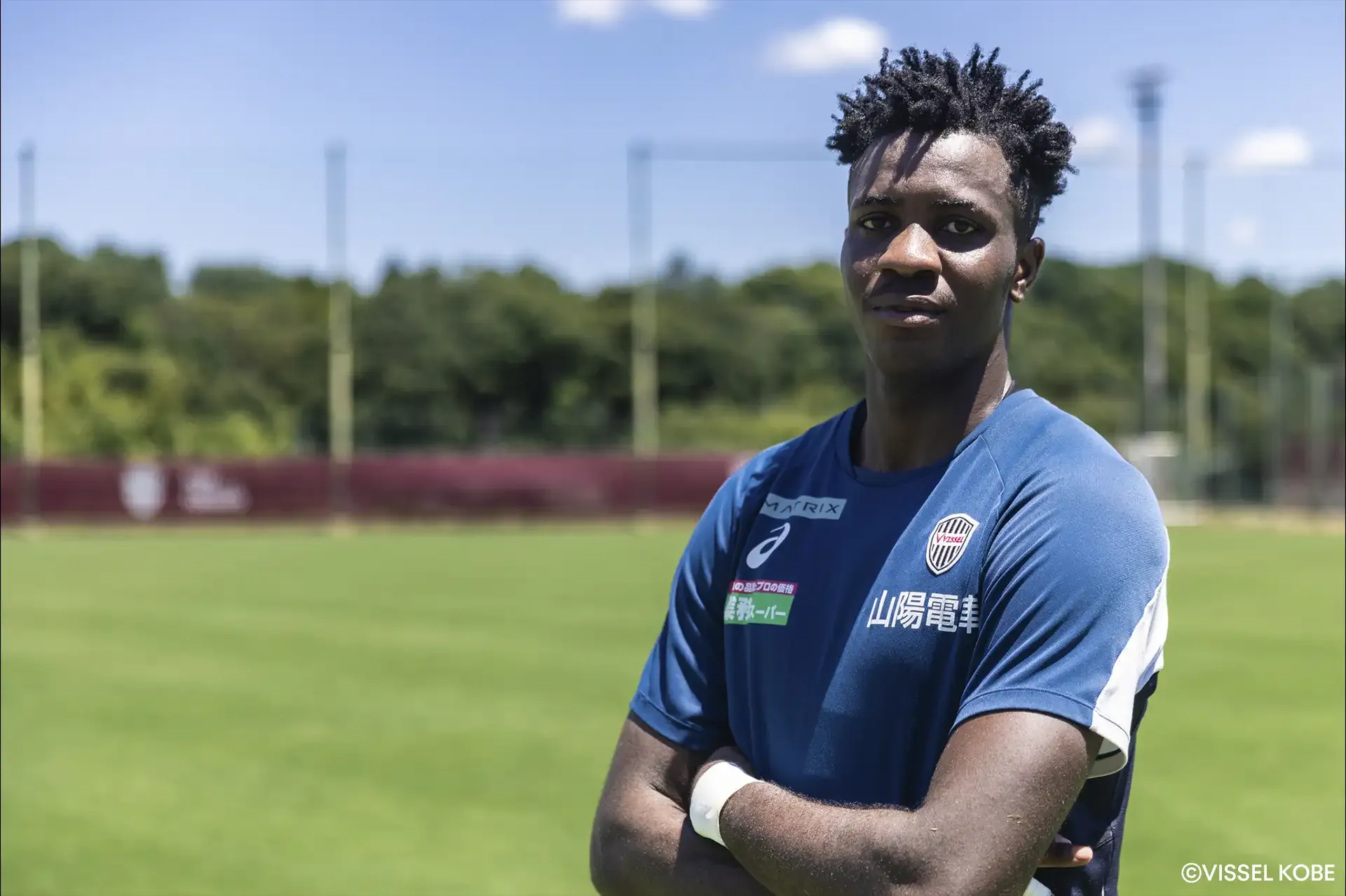
With a warm, gentle smile and his eyes shining, Richard looks to the future — poised to pounce.
Interview and text by Misa Takamura
