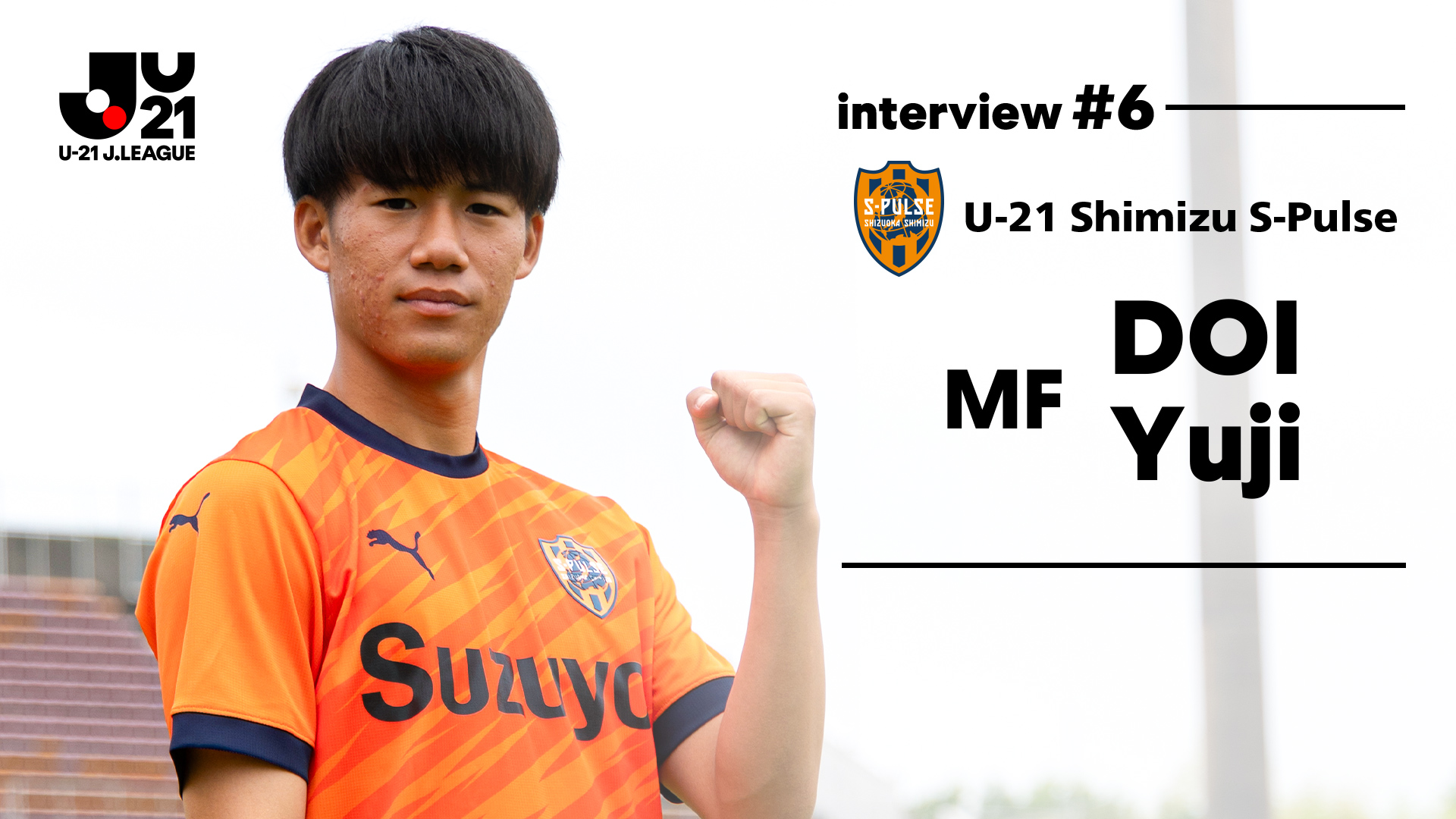
The U-21 J.League kicks off on 22 August. Newly established to accelerate the development of Japanese football and give young players a stage on which to challenge themselves, the league will bring together talent with the potential to represent Japan at senior level in the years ahead. In *Poised to Pounce*, we take a closer look at the careers and personalities of the next generation of players expected to make their mark. Part Six traces the roots of Shimizu S-Pulse’s gifted left-footer Yuji Doi, exploring how his love of the game developed and eventually led him towards a professional career.
■ Named an outstanding player in a third-grade tournament at the age of six
“The team I joined did a lot of dribbling practice, and I absolutely loved dribbling. I loved trying to outwit opponents, nutmeg them or use a one-two to get past them. Anything that let me take someone on and beat them was fun, and I was completely absorbed in it every day.”
That is how Yuji Doi remembers his early years in primary school.
The 19-year-old attacker, promoted to Shimizu S-Pulse’s first team from the youth side this year, combines a wide range of skills on the ball with agility, sharp dribbling and quality with his left foot. Supporters see him as a player who could become a central figure for the club in the years ahead.
He is also one of the talents to watch in the U-21 J.League, but it all began with a football-mad boy for whom the phrase “the ball is my friend” seemed particularly apt. Like many children, Doi was drawn into the game by an older sibling. His brother Hideaki, four years his senior, played football, and Doi naturally began kicking a ball around with him from as early as he can remember. At six, he joined the local Kanbe FC youth side in his hometown of Tsu, Mie Prefecture.
Even at that age, there was something special about his ability. Around six months after joining, while still only six years old, he took part in a tournament for third-graders. He dribbled past several older players to score and received an outstanding player award. Watching such a small child glide past boys several years older, plenty of onlookers must have wondered whether they were witnessing a prodigy.
Off the pitch, however, Doi was quiet and unassuming, and the early praise never went to his head.
“I loved scoring after dribbling past a few players, and I loved setting up goals too. Honestly, all I remember is being completely absorbed in football and playing all the time.”
After training, Doi would continue kicking a ball around with his brother, playing one-on-ones and learning new techniques from him. Regularly playing with older age groups also accelerated his development. Even if players his own age could not always keep pace with him, his brother remained a high bar to clear and kept alive his desire to challenge himself.
“My brother had a huge influence on me. I’m really grateful to him.”
■ Was he originally right-footed or left-footed?
One story often told about Doi is that he started out right-footed before becoming left-footed, but his own memory is slightly different. He is unquestionably right-handed, yet he has no recollection of ever being right-footed.
“Honestly, as far back as I can remember, I was kicking with my left.”
His brother is comfortable with both feet, while, perhaps surprisingly, there are plenty of players — including fellow S-Pulse player Keigo Suzuki — who are right-handed but naturally left-footed.
What Doi does remember is watching videos of Lionel Messi and constantly trying to imitate him.
“Maybe I started using my left foot without even realising it because I watched Messi so much.”
Whether he really began as a right-footer or was left-footed all along remains something even Doi himself cannot answer.
The youth team he played for was not a local powerhouse, either in terms of numbers or results. With Doi leading the attack, however, they won back-to-back tournaments in his final year of primary school, achieving results the club had not enjoyed for some time. It was also an environment in which he could play exactly the way he wanted without holding back.
When he entered junior high school, Doi joined H&A FC Junior Youth, an emerging club in Tsu. He had attended H&A FC’s football school since primary school and was invited to join, while he also felt that the club’s coaching philosophy and style suited him.
“We were a team that tried to keep the ball on the ground and pass rather than just knocking it long. We attacked in combinations, with good spacing between us. I usually played as a No. 10 or wide midfielder, and very occasionally as a defensive midfielder. I was given a lot of freedom — the message was basically, ‘If you get the ball, take players on.’”
The role played to Doi’s strengths, and he began appearing in matches alongside third-year students soon after joining. But as a naturally small first-year junior-high student, the physical difference was considerable, and he could no longer play quite as freely as he had in primary school.
“I’d always been confident one-on-one because I’d been taking players on since primary school. But the third-years were much bigger than me, and I wasn’t very strong physically, so once they made contact with me it was tough. My coach and team-mates taught me ways to avoid contact — getting into position early, slipping away from opponents and thinking more carefully about where to take players on.”
■ A major shock on tour with the U-15 Japan National Team
As Doi learned to overcome those challenges and began to show more of his ability, he caught the eye of Shimizu academy scout Yuki Uekusa while still in his first year of junior high school. Uekusa travelled to Mie to watch a U-13 league match, spotted Doi and quickly made contact.
Doi was subsequently approached by a number of J.League clubs, but Shimizu had been the first to show an interest, while the level of the academy also appealed to him. He decided at an early stage that he would leave home and join Shimizu S-Pulse Youth.
During that process, former Japan international Ryuzo Morioka, then head of coaching at the Shimizu academy, also went to watch Doi play. He remembers being struck almost immediately.
“From his very first involvement, I thought, ‘Who is this kid?’ He had incredible dynamism and looked completely in tune with the ball. He really had that ‘the ball is my friend’ feel about him. He was very athletic too — he could turn sharply and dart past players. I remember saying to Uekusa, ‘You’ve found a good one.’ Even after he came to S-Pulse, he still had this aura of a kid who lived and breathed football — the kind you could imagine actually sleeping with the ball.” — Ryuzo Morioka
Morioka has long stressed the importance of retaining that pure love of football even after becoming a professional. Doi was already showing exactly that during his junior-high years.
“I’d see something interesting in a video, or some kind of play people wouldn’t normally try, and then try it in a match. Even if it was the sort of thing I might get told off for if it went wrong, I’d still think, ‘I want to try that.’ If I lost the ball and didn’t immediately try to win it back, of course I’d get told off. But as long as I went all out to get it back, the coach wouldn’t say anything. I think that gave me an environment where I felt free to try things. He’d been watching me since primary school, so I trusted him, and what I wanted to do on the pitch was pretty close to what he wanted from me too. I could play without second-guessing myself. Choosing H&A FC when I started junior high school was definitely the right decision.”
It was in his third year of junior high school that Doi received his first call-up at youth international level, travelling to Spain with the U-15 Japan National Team.
“It was my first time being selected for Japan and my first time playing football overseas. On top of that, we were going to a country I loved, so I couldn’t wait. But once we actually played teams from overseas, I realised there was a huge difference in level. They kept the ball and passed it so well — it almost felt like professional football. The match against Spain especially sticks with me. It felt like we were playing against adults.”
Lamine Yamal and Pau Cubarsí are the same age as Doi, although both were already playing above their age group for Spain and were not involved in the side Japan faced. Even so, the Spanish team contained a number of players from Barcelona and Real Madrid. Seeing their level and mentality up close was a shock unlike anything Doi had experienced before.
“I realised just how different the level was, and I came home having taken so much from the experience. It made me want to get much better and play at a higher level. It was an experience that made me seriously think, ‘I really want to become a professional.’”
■A goal on his first-team debut — and a roar he will never forget
Doi joined Shimizu Youth with that determination, but life in Shizuoka also gave him plenty of inspiration away from the pitch.
“Whenever I went into town on a day off, there were S-Pulse posters and flags everywhere, and orange all over the place. I could really feel how much the city loved the club, and it felt like a real football heartland. The atmosphere at IAI Stadium Nihondaira is amazing too. It made me want to become a professional as soon as possible, have people cheering me on and perform well.”
His start at Shimizu did not go to plan. An injury before he had even joined the team set him back several months. Even after returning, he was unable to regain his fitness in time for that summer’s Club Youth Championship.
“Takeru Iwao and Ibuki Oishi, who were in the same year as me, were both starting at the Club Youth Championship. I was really frustrated.”
Still, Doi kept moving forward, guided by a simple idea: “I tried to make sure I improved in at least one way every day — to be better tomorrow than today, and better the day after that than tomorrow.” He kept a football notebook as he worked on the defensive side of his game, while also paying close attention to his diet and training to build himself up physically. From the summer onwards, his playing time steadily increased.
By his second year, Doi had become one of the team’s key players. Feeling that he needed to become more clinical in the final third, he worked on his shooting accuracy and movement around goal.
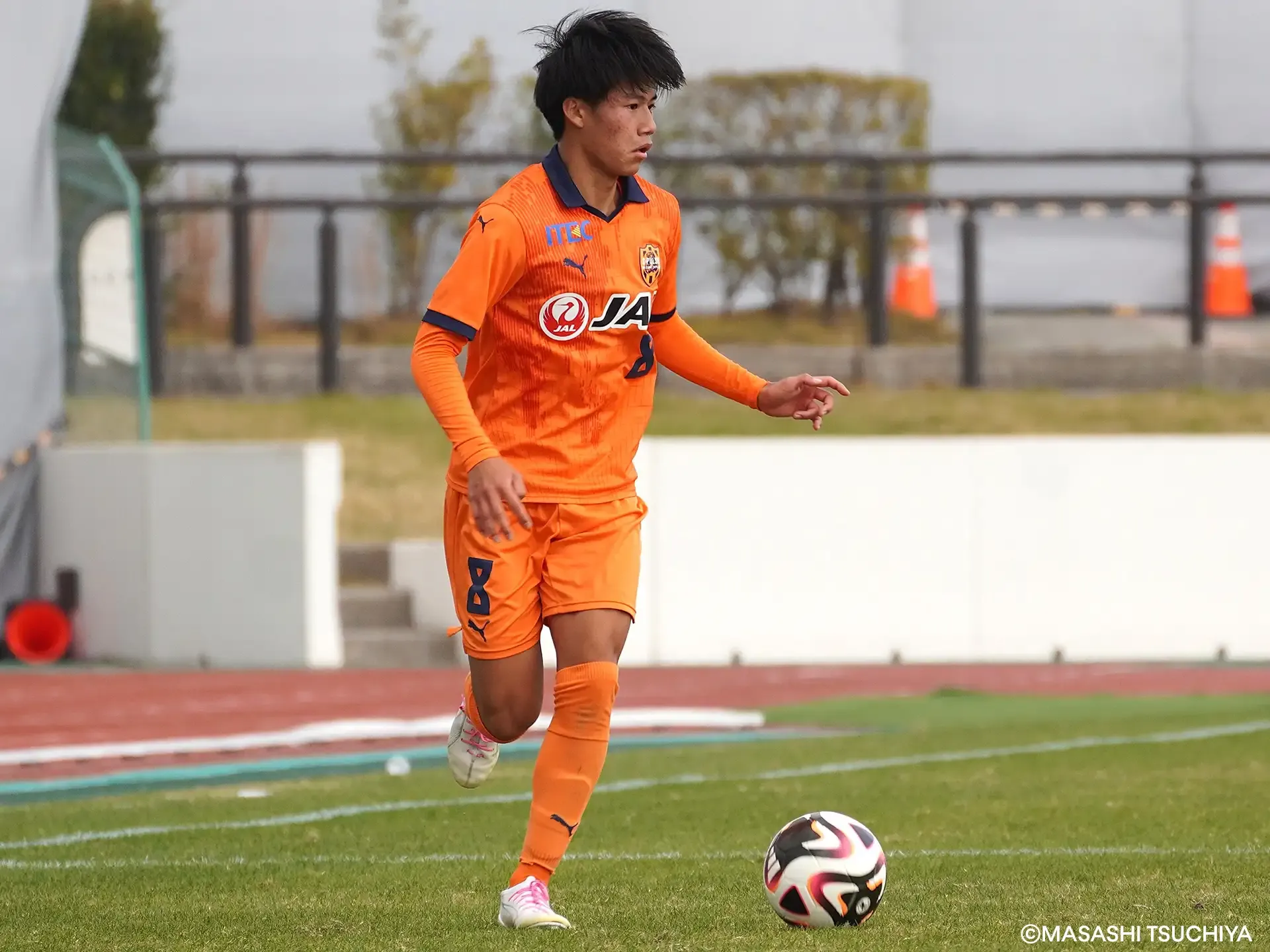
That work paid off on 26 March 2025. Doi made his senior competitive debut at the age of 17 in the first round of the J.LEAGUE YBC Levain CUP against S.C. Sagamihara, coming on in the 72nd minute. Thirteen minutes later, he calmly converted a pass from fellow S-Pulse academy graduate Koya Kitagawa with a first-time left-footed finish to score on his debut.
“Kitagawa gave me a perfect pass and all I really had to do was finish it, so I was more relaxed than I expected when I took the shot. The moment it went in, the supporters erupted. I was absolutely delighted, and I’ll never forget that roar.”
The confidence from that goal carried into the Prince League Tokai, which began in April. Doi scored freely, including hat-tricks in successive matches, and his rapid development as a finisher helped pave the way for his promotion to the first team.
■Why he asked for the No. 33 shirt
At youth international level, however, Doi had more cause for frustration. He was called up to the U-17 Japan National Team only once, in the summer of his second year, while his team-mate Ryota Hariu was selected regularly.
“When I was called up to the U-17s, I noticed that the other players weren’t just intense — they also set really high standards for the quality of their own play. It made me realise I needed to change the way I approached training. When Hariu was away with the national team, I was frustrated, even if I didn’t show it. But that just made me want to work harder, and I think we had a good rivalry and pushed each other in a positive way.”
His three years with Shimizu Youth also brought the disappointment of losing in the U-18 Premier League promotion play-offs three years running. Things did not always go his way, but those setbacks helped him develop a determination to use frustration as fuel.
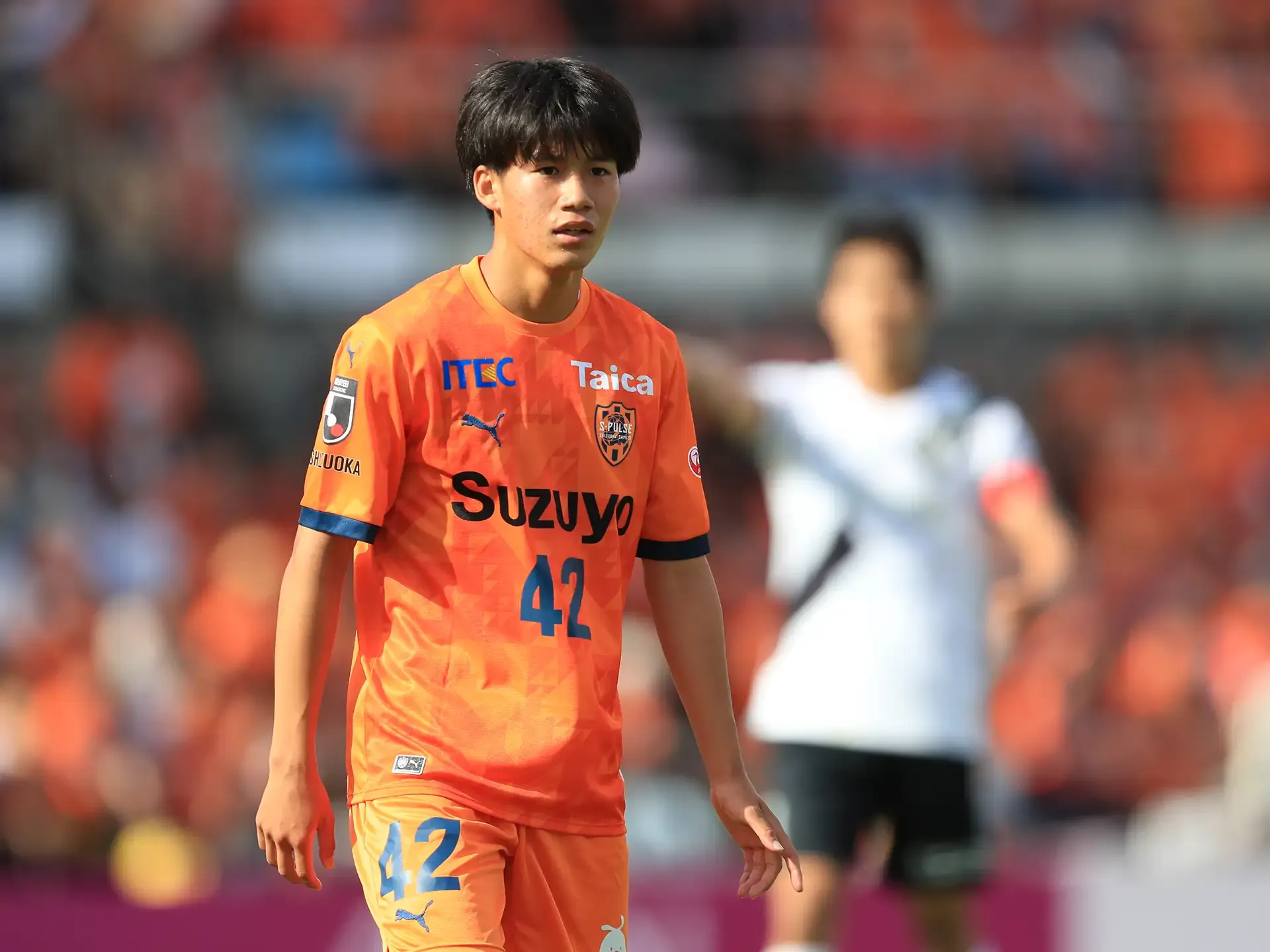
When Doi officially became a professional this year, he personally asked to wear No. 33 — the number Takashi Inui, now with Jubilo Iwata, had worn the previous season.
“Of course Inui is an incredible player, but I was drawn to him as a person too. He genuinely loves football, he’s full of energy and he has a positive influence on everyone around him. Whenever I trained with the first team, I naturally found myself watching him. I learned so much from seeing what he focused on in training and how he moved off the ball.”
“More than anything, I really admire how much he enjoys playing. I want to become the kind of player my team-mates and manager trust enough to think, ‘If he’s here, we’ll be fine.’ That’s why I chose the same number.”
As a senior player who has never lost that pure love of the game, Inui remains the ideal role model for Doi.
■ A valuable 14 minutes — with eyes on a brighter future
Doi was limited to a single 14-minute appearance in the MEIJI YASUDA J1 100 YEAR VISION LEAGUE, a situation he could hardly be satisfied with. Under Takayuki Yoshida, even greater intensity is now required in both attack and defence, presenting another challenge for Doi to overcome.
“I definitely felt I was still lacking in a lot of areas when it came to what this team is trying to do. But I’m working on them every day, and I’m making sure I’m ready whenever my chance comes. I only came off the bench once in six months, but that experience was huge for me. I learned both where I still fall short and where I can hold my own. Over those six months, I also changed the way I watch the players who are getting on the pitch — trying to pick up the things they do well and adapt them to my own game.”
The attacking ranks have become even deeper heading into the 2026/27 season, raising the bar Doi must clear. But he has no intention of being discouraged. The launch of the U-21 J.League also gives him an important opportunity to gain competitive experience.
“Of course, playing and performing well in J1 is my biggest goal. I’m working in training to improve the areas where I’m still lacking, and this year we’ve been given the U-21 J.League as another stage to show what we can do, so I want to make the most of it. People will come to watch, and I want to make them think, ‘That was exciting,’ or ‘That was a great bit of play,’ as often as I can.”
Doi wants to become a player who, like Messi, whom he has admired since he first started playing football, and Inui, whom he looks up to, can receive the ball and make a difference even in tight spaces. At this year’s World Cup, the player who made the biggest impression on him was Yamal, who is the same age as Doi and also left-footed.
“Yamal was a key player in a World Cup-winning team at that age, and players my age or even younger were doing well for other countries too. It made me feel the gap between myself and the rest of the world, but at the same time it made me want to work even harder so I can reach that stage myself. I don’t see it as somewhere that’s out of reach. I want to improve even faster so that next time I can be on that same stage.”
Doi still has a gentle, youthful look, but when he talks about his future, the ambition in his expression and eyes is unmistakable. He is biding his time — poised to pounce when his chance comes.
Interview and text by Yoshio Maeshima
