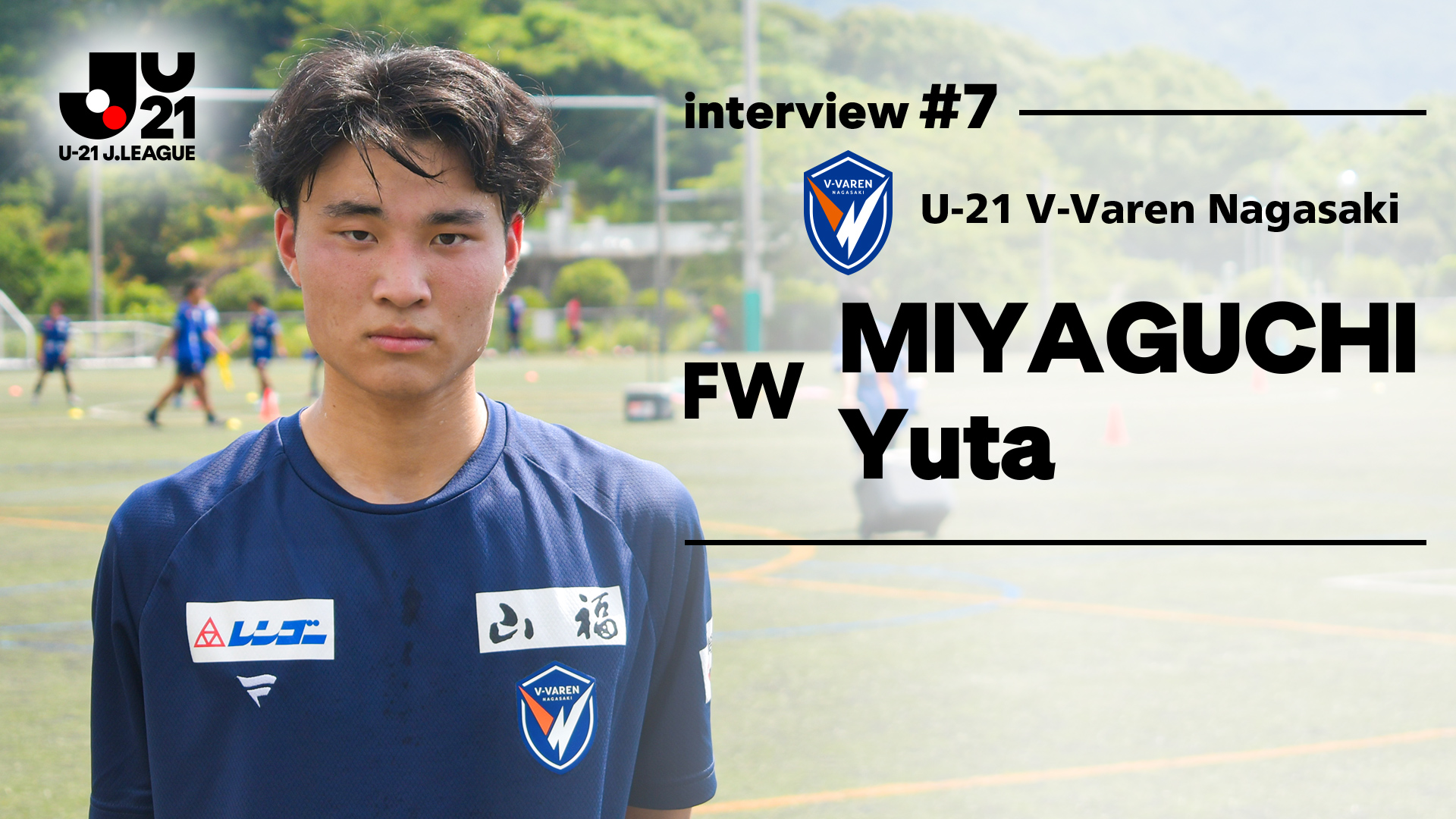
The U-21 J.League kicks off on 22 August. Newly established to accelerate the development of Japanese football and give young players a stage on which to challenge themselves, the league will bring together talent with the potential to represent Japan at senior level in the years ahead. In Poised to Pounce, we take a closer look at the careers and personalities of the next generation of players expected to make their mark. In Part Seven, we hear from V-Varen Nagasaki U-18’s leading striker Yuta Miyaguchi as he speaks with conviction about his hopes for the future.
■ A career that began in Miyazaki — the roots of a striker
In the summer of 2026, the name of a final-year high school student sits at the top of the scoring charts in Prince League Kyushu Division 1. V-Varen Nagasaki U-18 striker Yuta Miyaguchi has scored 11 goals in nine matches. The numbers are impressive, but there is no dramatic story behind them. Rather, they are the product of three years of doing the basics over and over again and constantly looking for opportunities in front of goal.
“I focus on doing the basic things properly — how many times I can make runs into the box, how many more actions I can make, and making sure I finish the few chances I get.”
Asked what lies behind his good form, Miyaguchi’s answer is remarkably straightforward. He does not point to any special tactical change or sudden technical breakthrough. Make more runs. Make more actions. Finish the few chances that come his way. That is all. Yet how many players can keep doing those things for 90 minutes, throughout an entire season? That is where Miyaguchi believes his value lies.
Born and raised in Miyazaki Prefecture, Miyaguchi was introduced to football by his older brother.
“My brother was already playing, so I started because of him. He was also the reason I first kicked a ball.”
And the moment that captivated him as a boy has remained the same ever since.
“It’s definitely the moment I score. I’ve been a forward since I was little, so there’s nothing better than the joy of scoring and having everyone come over to celebrate with me.”
That joy of scoring has been at the heart of his career as a forward from the very beginning.
Miyaguchi spent his primary school years with ARRIBA FC before joining Central FC Miyazaki in junior high school. Both are among Miyazaki’s leading clubs. His reason for choosing Central, however, was also a very practical one.
“The biggest thing was that they had a shuttle bus.” [laughs]
But it was there that he met a coach who would change his approach to the game.
“Coach Onishi was very good at developing forwards, and he was tough on me. Because of him, I became more motivated to work hard. I had a tendency to slack off, but he pushed me to put the work in, and I started doing my defensive work properly too.”
Although much of the attacking responsibility was placed on him, there was one message he heard repeatedly: “Win games for the team. Take responsibility.”
Scoring goals and winning games for the team became inseparable in his mind. That lesson can still be seen in the way he now scores goals while also carrying out his role in the team’s collective defending from the front.
His path was not entirely smooth. His final year of primary school coincided with the COVID-19 pandemic.
“I was anxious because we couldn’t do things we should normally have been able to do. ARRIBA FC had qualified for the national tournament, but I remember wondering whether the tournament would actually take place.”
Fortunately, it did. But for a 12-year-old, the possibility that a door he had worked towards might close for reasons entirely beyond his control was a heavy burden to carry.
■ The meaning behind No. 13 — inherited from an admired senior
As Miyaguchi approached the end of junior high school, he faced a major decision. Many players from Central FC Miyazaki go on to local powerhouse Hosho High School and set their sights on the All Japan High School Soccer Tournament. For young footballers in Miyazaki, it is one of the most straightforward paths available.
Miyaguchi chose instead to leave the prefecture and join V-Varen Nagasaki U-18.
“Players from Miyazaki such as Harumu Nabeshima and Aoto Nanamure had joined V-Varen’s youth team and gone on to become professionals, and that was the biggest factor. I also wanted to build a solid foundation at a J.League club.”
Rather than aim for the high-profile stage of the All Japan High School Soccer Tournament, Miyaguchi chose a path towards professional football. For a 15-year-old, it was a decision made with his future firmly in mind.
Life in Nagasaki, however, was not quite what he had imagined.
“I thought teams at J.League clubs might not do that much running, but running was just a normal part of training. Every day was tough. I think it made me stronger both physically and mentally.”
He had imagined an environment centred more heavily on technique, only to find one where running was a basic requirement. That physical workload would serve him well later on.
His first year with the U-18s was disrupted by injury, leaving him unable to play for a period.
“I got injured in my first year, and I was so frustrated that I did strength training every day.”
Miyaguchi channelled that frustration into his physical development and finally made his Prince League debut towards the end of the season. But the experience ended on a bitter note.
“I got to play in the final match, but we lost. I felt a mix of frustration and regret that I hadn’t been able to play sooner. But then I decided that the next year I wanted to be at the heart of the team and lead us to wins. I knew I had to work towards that.”
During that same first year, Miyaguchi and three third-year team-mates came across an elderly person who appeared to be suffering from heatstroke on their way home from training. They stopped to help and called an ambulance. The incident was later featured in a local newspaper. In the photograph, Miyaguchi is taller than the third-years and looks at first glance like the senior member of the group, even though he was still a first-year player with limited opportunities on the pitch. It was a frustrating period for him.
Yet it was also around this time that the idea of becoming a professional began to feel more real.
“Nanamure, who was the team’s main striker at the time, was promoted to the first team, and I was given his No. 13 shirt. Taking over that number made me feel that people expected something from me, and it made the path to becoming a professional feel much clearer.”
Seeing a senior he admired make the step up gave Miyaguchi even greater motivation.
■ Signs of a breakthrough — climbing the ladder step by step
In his second year, Miyaguchi became the team’s main source of goals. He scored seven times in 18 matches in Prince League Kyushu Division 1, finishing joint-sixth in the scoring charts. He was also a key player in the Boys category at the Japan Games and was selected alongside V-Varen team-mate Yamato Ota for a Kyushu Training Centre U-17 select squad that competed at the SANIX Cup International Youth Soccer Tournament.
He was steadily climbing the ladder.
V-Varen Nagasaki U-18 head coach Takeo Harada had already spoken highly of that age group in 2024, when Miyaguchi was a first-year player, saying there were “a lot of exciting players” in the group. The following year, he again spoke of his expectations for the players moving into their second year. It was clear that Harada had been watching the group closely from an early stage.
Harada describes Miyaguchi’s strengths in these terms:
“I think one of his strengths is the variety of ways he can score. He can score with his head, his right foot or his left. His movement is also very fluid, and the way he gets himself into shooting positions, as well as his ability to get a shot away even when off balance, sets him apart from other forwards.”
Head, right foot, left foot — Miyaguchi has a wide range of ways to score. He can work himself into shooting positions in different ways and still get efforts on target even when off balance. Despite standing 180 centimetres tall and weighing 69 kilograms, his movement remains fluid. Harada’s words highlight his all-round ability as a forward.
Miyaguchi himself looks to Real Madrid forward Kylian Mbappé as a role model.
“His runs in behind are really good, and I study his shooting too. I also try to watch the defenders’ positions and time my own runs in behind.”
The key is that Miyaguchi watches the defenders’ positions. He does not simply run. He observes his opponent, looks for the opening and makes his move at the right moment. It is a fitting image for the idea behind Poised to Pounce: a forward watching his opponent closely and waiting for the right moment to strike.
The Japanese expression koshitantan, rendered in the title of this series as Poised to Pounce, comes from the ancient Chinese I Ching, or Book of Changes. It evokes the image of a tiger watching intently for the right opportunity, while in modern Japanese it is commonly used to describe someone patiently waiting for the right moment to make their move. In Miyaguchi’s case, however, the two meanings seem to overlap: the eye for an opening in front of goal and the attitude of continually working to improve himself.
■The leading striker sets his sights on the club’s first promotion to the U-18 Premier League
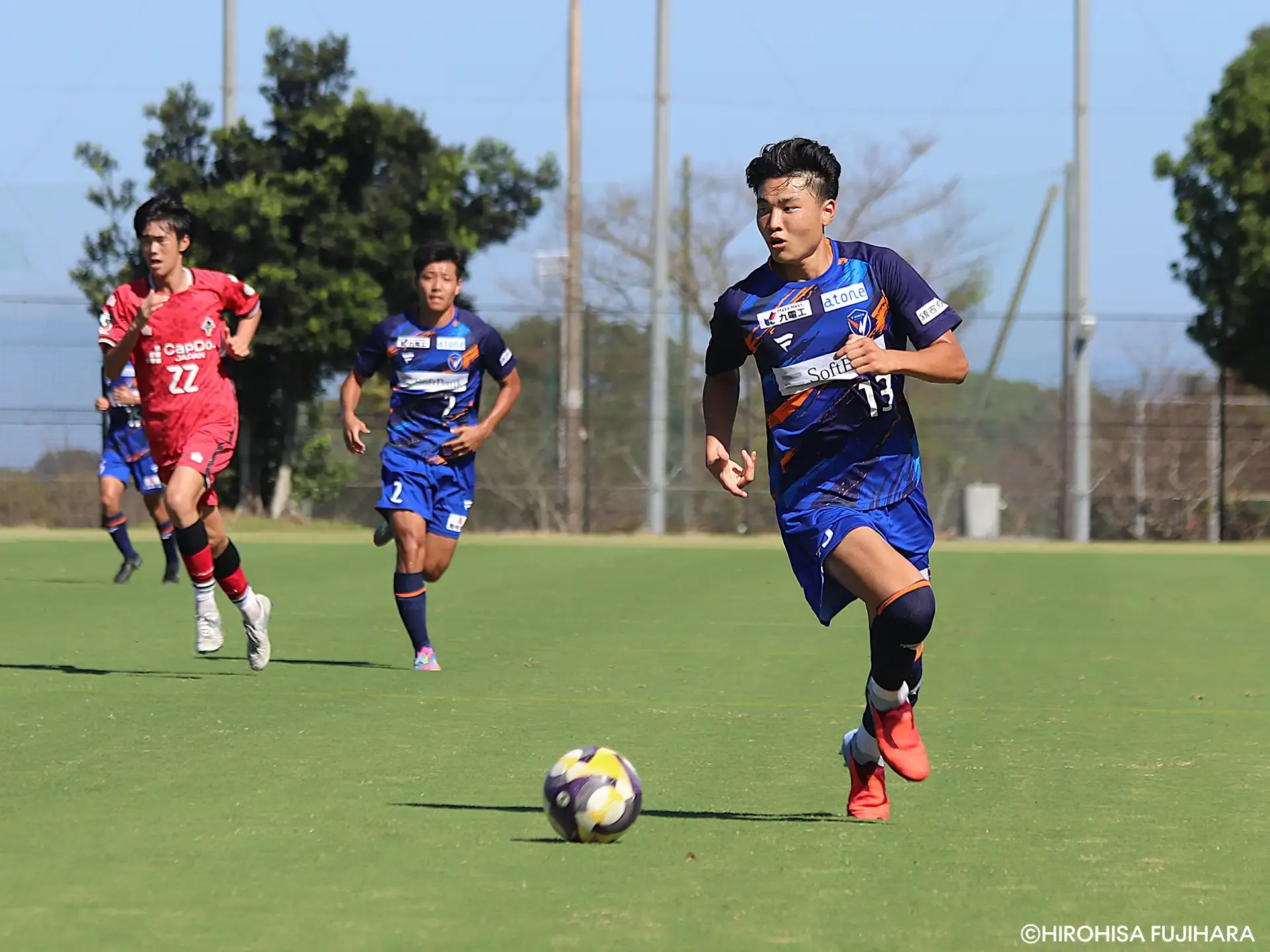
Now in his final year, Miyaguchi is leading the team as its main striker. His 11 goals in nine Prince League Kyushu Division 1 matches put him at the top of the scoring charts. He attributes that form not only to his own development, but also to changes within the team.
“As a team, one of our aims defensively is to win the ball as high up the pitch as possible. That gives us a lot of chances to counter quickly after winning it high, so I think I’m getting more opportunities than I did last year.”
His 11 goals reflect individual development and team progress coming together.
But Miyaguchi’s sights are set further ahead, where a very real obstacle remains.
V-Varen Nagasaki U-18 won Prince League Kyushu Division 1 in 2021 and reached the last 16 of the Japan Club Youth Football Championship (U-18) in 2023, only the second time in the club’s history they had reached that stage. Over the following three seasons, however, injuries, conditioning issues and a shortage of training facilities have prevented the team from achieving the results they wanted in either league or cup competition.
This season, helped by Miyaguchi’s goals, a first league title in several years and the club’s first promotion to the U-18 Premier League have come within realistic reach.
Miyaguchi has a clear view of what it will take.
“If things go as expected, I think we can win the Prince League. After that, we’ll have to beat strong teams from Kanto in the promotion play-offs. Nagasaki have reached that stage before only to fall short. We’ve played teams from Kanto in pre-season friendlies, and I don’t think there’s a big gap, so the key is learning how to win when it matters.”
He believes there is little between the teams, yet Nagasaki have repeatedly fallen short. Miyaguchi sees the ability to win when it matters as the difference.
“If we can avoid carelessly dropping points in the second half of the Prince League season, I think we’ll become better at getting results when it matters. When it’s 0-0, can we find a way to win? Can we score the goal we need? That will be essential if we’re going to make it through the U-18 Premier League promotion play-offs.”
Can he find a single goal when a match is locked at 0-0? That is precisely the job of a striker. Miyaguchi understands that responsibility for achieving the team’s objective also falls directly on him. The words drilled into him during his junior-high years — “Win games for the team. Take responsibility” — take on fresh meaning here.
■ An 18-year-old’s resolve: ‘I will definitely become a professional’
“It may not be a league where results are everything. But in terms of individual development, I think it will be a really valuable experience for young players. If U-18 players get the chance to play, I want them to approach it as a place where they can improve.”
That is what U-18 head coach Harada hopes the U-21 J.League will provide: not simply a place to gain experience, but a place for young players to develop.
He also points to the level of challenge the competition may offer.
“I hear that teams like Urawa and Kobe have been training their U-21 squads together from an early stage. There may also be newly arrived foreign players or key players returning from injury who use the matches to regain fitness. I want our players to experience all of that.”
It will not be a sheltered environment. That is precisely why Harada sees value in it.
Miyaguchi is equally clear about what he wants from the competition — and where he wants it to lead.
“I want to perform well, definitely become a professional, keep scoring at professional level and become a player who earns a call-up to the national team. I’ve been scoring in consecutive matches recently, so I want to keep this form going and, if I get the chance to play in the U-21 J.League, score even more.”
In the summer of 2026, Miyaguchi’s name still sits at the top of the Prince League Kyushu Division 1 scoring charts. But those numbers are not the destination. There is promotion to the U-18 Premier League, a hurdle the team has repeatedly failed to clear. There is the dream of becoming a professional. And beyond that lies the Japan National Team.
Yuta Miyaguchi now has all of them firmly in his sights.
Make more runs into the box. Get involved more often. Finish the few chances that come his way. That relentless repetition is his weapon. The U-21 J.League is an ideal stage on which to show it.
Interview and text by Hirohisa Fujihara
