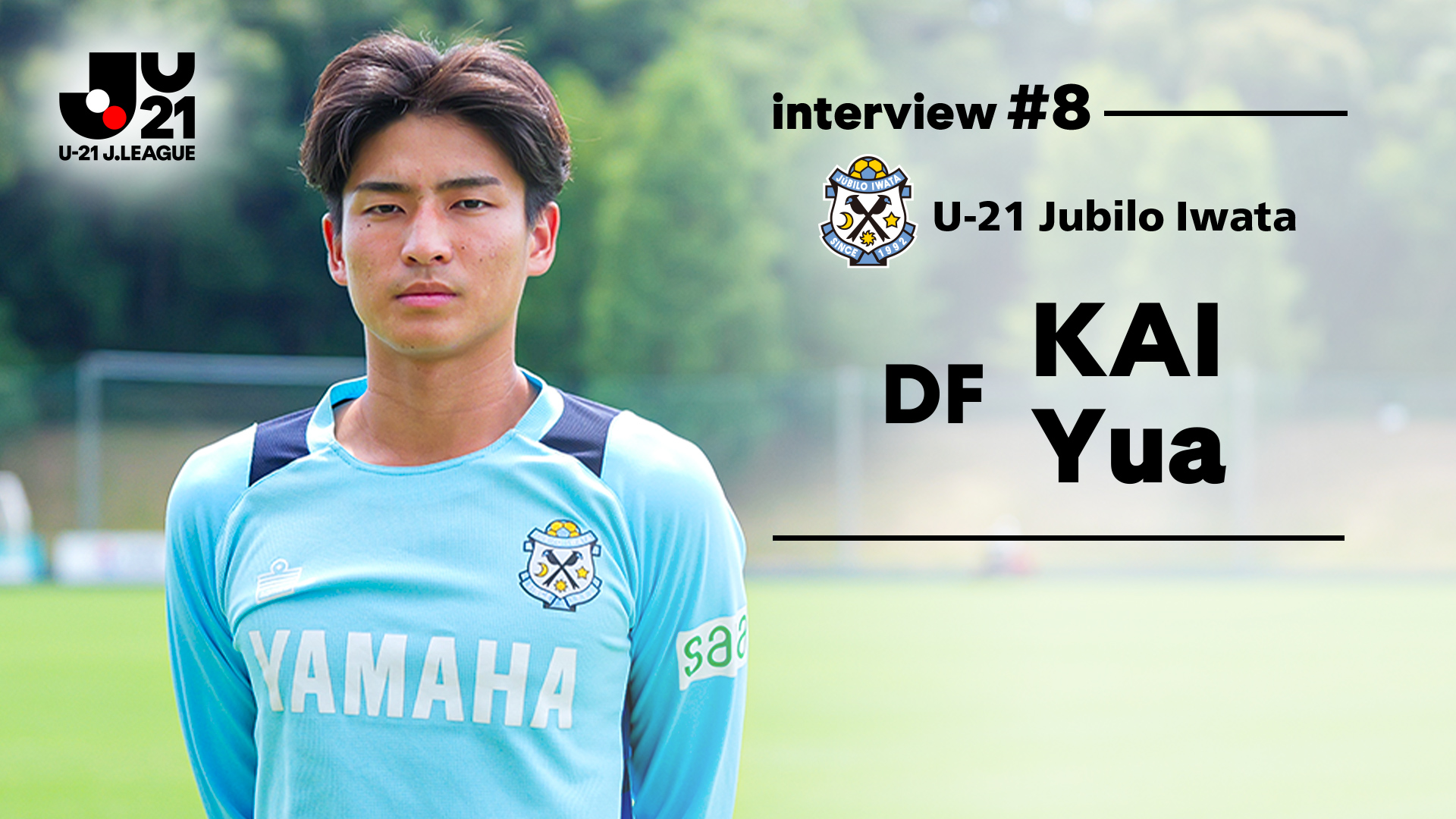
The U-21 J.League kicks off on 22 August. Newly established to accelerate the development of Japanese football and give young players a stage on which to challenge themselves, the league will bring together talent with the potential to represent Japan at senior level in the years ahead. In Poised to Pounce, we take a closer look at the careers and personalities of the next generation of players expected to make their mark. Part Eight features Jubilo Iwata centre-back Yua Kai, whose football has been shaped by Shizuoka’s rich football culture.
■ His first move came in the summer of fifth grade
The Saxe Blue shirt has been part of Kai’s life since junior high school. Now, still wearing it as a professional, he is enjoying his new life while looking forward to how much further he can develop. His aim is simply to give everything where he is and keep moving forward, centimetre by centimetre, millimetre by millimetre.
“Unlike when I was in the academy and still going to school, life now revolves around football, so at first it felt a bit strange and took some getting used to. There was also this hard-to-describe feeling about it. But being able to think about football all day is a fantastic experience, and it’s not something everyone gets to do, so I’m really enjoying it now.”
The 19-year-old is comfortable with either foot and has the potential to become a defensive leader for Jubilo in the years ahead. With the approach to the game he has developed in Shizuoka, Kai is looking ahead to the day when he can become a leading figure at Yamaha Stadium.
A major turning point in his life came just before he started primary school. His father had played softball and was passionate about the sport, so Kai had grown up familiar with it. But one day, he accompanied his older brother to an event that would change the course of his life.
“Before I started primary school, I’d always thought I was going to play softball. Then I went along to a trial for a youth football team that my brother was taking part in, and I ended up joining in halfway through. I thought, ‘Football’s fun,’ so I decided, ‘I’ll play football instead of softball.’ It really was just a spur-of-the-moment decision, but now that I’ve become a professional, I’m grateful to my brother.”
A casual decision at the age of six ended up shaping the course of his life.
Kai joined Takasu SSS in his first year of primary school. He played in attacking positions such as forward and attacking midfield and fell in love with the game in a team that gave him plenty of freedom.
“They let me play really freely. I hardly did any defending at all.”
Kai’s ability to use both feet, now one of the distinctive features of his game, also appears to have developed during his primary school years.
“I’m naturally left-handed, but at first I could only kick the ball with my right foot. My father said, ‘You’re left-handed, so why don’t you try kicking with your left?’ I went through a period where I only used my left foot, and before I knew it I could use both. But I hold things like chopsticks with my left hand and throw a softball with my right. I’m not even really sure myself which side is my dominant one.” [laughs]
His first move between clubs came in the summer of fifth grade. Kai decided to commit himself more fully to football by joining Shuriki HANASHI FC, coached by former J.League player Mitsutoshi Tsushima, who had also coached him at the Fujieda training centre. The warm send-off he received from his Takasu SSS team-mates remains a treasured memory.
At Shuriki HANASHI FC, Kai finished third in the Shizuoka prefectural tournament in both fifth and sixth grade, steadily developing his ability in a high-level environment. When the time came to choose a team for junior high school, he initially planned to join local side Fujieda Meisei SC Junior Youth. However, Tsushima, who rated Kai highly, encouraged him to try out for the two J.League academies in Shizuoka.
He reached the final stage of both trials. He was not selected by Shimizu S-Pulse but was accepted by Jubilo Iwata.
“There was something called the ‘Concorde Seat’ at Nihondaira, and I often went to S-Pulse matches with everyone from my team. But I wasn’t particularly interested in Jubilo — I hardly knew any of their players.”
It proved to be another major turning point. Kai would spend his three junior-high years with Jubilo Iwata U-15, a path he had never imagined taking.
■ Looking back on his U-15 years — commuting by train from Fujieda to Iwata
The standard around him was high, and adapting to it was challenging enough. On top of that, commuting from Fujieda to Iwata for training every day was no easy task for a junior-high student. In his first year in particular, balancing school and football took its toll.
“I’d get everything ready for Jubilo in the morning and put my gear in the car. When school finished, my mother would pick me up, I’d change in the car, she’d take me straight to Fujieda Station, then I’d go to Iwata and come home afterwards. Every day was like that, and it was really tough. That first month especially, I was just trying to get through each day.”
One turning point came in his second year, in a Club Youth Championship group-stage match against Tokyo Verdy Junior Youth — a match Kai himself describes as “one I don’t want to remember”. He was selected to start, but Jubilo suffered a 7-0 defeat.
“We won the first match and decided to rotate the team for the second, so second-years like me and some third-years who didn’t usually play got the chance. But we were completely outplayed… I was frustrated, and more than anything, I felt awful for the third-years.”
Even so, Kai took a lot from the experience.
“Still, I learned a lot from that match. Rather than letting the defeat get me down, it made me think, ‘I’ve still got a long way to go.’ I tried to look at it positively: all I could do was keep improving and produce results further down the line. From then on, I decided to do everything I could.”
There is little doubt that the match reignited his desire to improve.
In his third year, Kai began joining U-18 activities more regularly and was sometimes given the chance to play in prefectural league matches. Surrounded by talented players including Keisuke Goto, now with SC Freiburg in Germany and a member of Japan’s squad at this year’s World Cup, Kai continued to develop. He moved up to the U-18s with the aim of turning professional three years later.
■ Regret in Hiroshima — and a vow to make amends
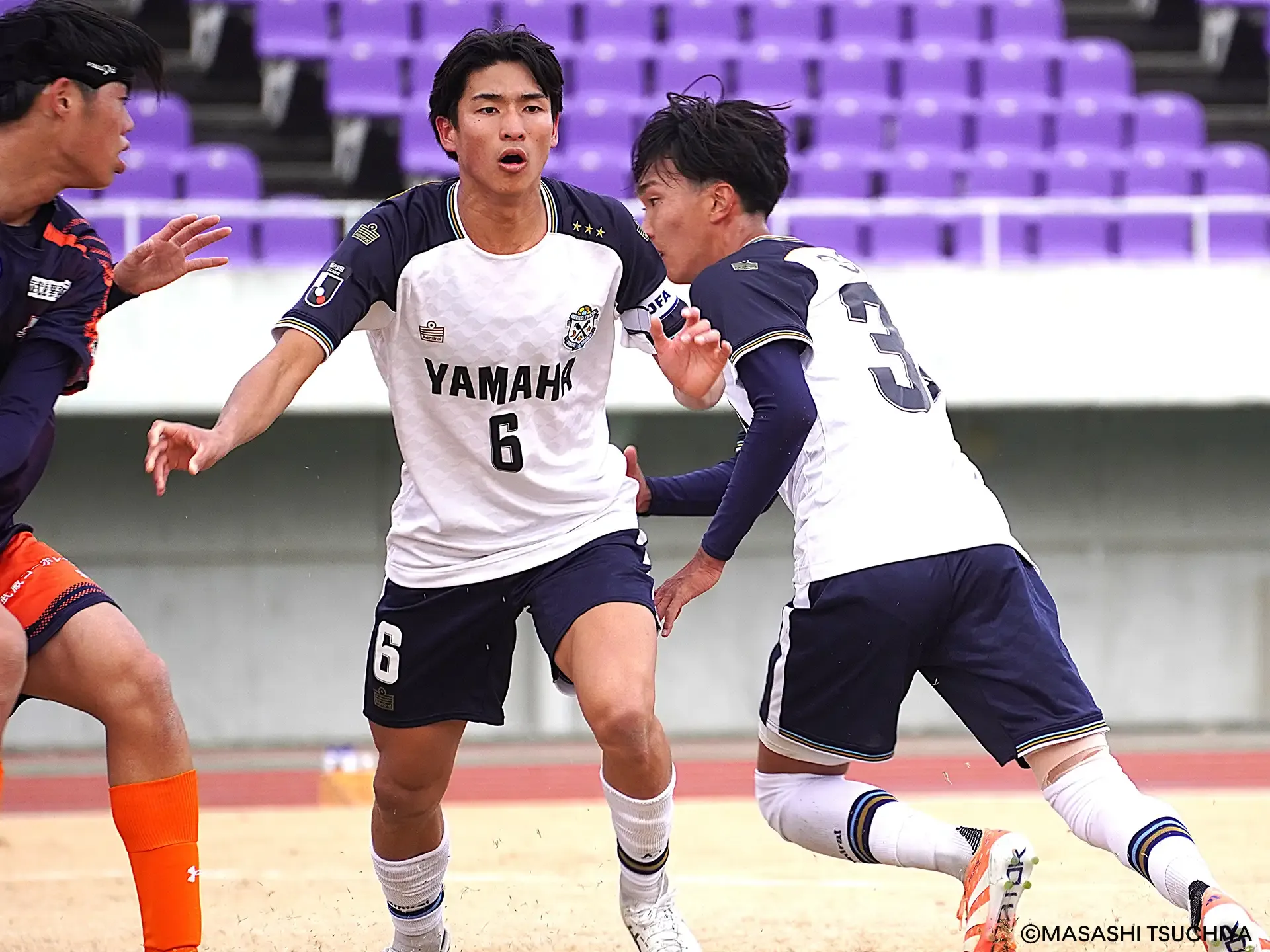
Kai’s U-18 Premier League debut came sooner than expected. In July of his first year, the 16-year-old, wearing No. 20, started at centre-back away to Ozu High School.
“It was so much fun. I was nervous before the match, but everyone helped me settle down. I didn’t play particularly well in the first half, but at half-time I felt the nerves lift, and in the second half I was able to play the way I wanted. We came from behind to win as well, so it’s one of the most memorable matches from my three years with the U-18s.”
Playing the full match in a comeback victory gave him real confidence.
Kai made one other start in the Premier League that season, also away from home, against Sagan Tosu U-18. It was only later that he realised who the forward he had faced that day was.
“After the match, I found out for the first time that the player I’d been up against was the same age as me. A few years later, I realised that player was Shion Shinkawa.” [laughs] “He was definitely quick and strong even then, and he had a buzz cut, so he stood out.”
Shinkawa went on to make his first-team debut while still at high school and now plays for Sint-Truiden in Belgium, where he is regarded as one of the leading attackers of his generation. It is a slightly unusual anecdote that offers a glimpse of Kai’s character.
In his second year, Kai’s main stage shifted to Prince League Tokai, where he established himself as the first-choice left-back and recorded more playing time than any other outfield player on the team.
One match from that year remains impossible to forget.
In December, at the end of the season, Jubilo Iwata U-18 faced Okayama Gakugeikan High School in the first round of the U-18 Premier League play-offs at Hot Staff Field Hiroshima. Jubilo took the lead but were pegged back in the second half and eventually lost the ensuing penalty shoot-out, ending their hopes of returning to the Premier League at the first attempt.
“I’d been expecting to spend my whole third year playing in the Premier League, so losing like that was really frustrating. After the match, when I thought, ‘I won’t get to play football with the third-years any more…’, the emotions just came out and I started crying.”
“But after that, I felt even more strongly that we had to be the ones to get promoted to the Premier League. I think that loss was both the last match of my second year and the first match of my third year.”
Kai left Hiroshima determined to return a year later with a different outcome.
■ Inspired by veteran Eiji Kawashima at the Kagoshima camp
Kai’s desire to earn promotion to the first team grew even stronger a month later, when he joined the senior squad for their training camp in Kagoshima. Over the course of the week, he gradually grew accustomed to the environment, and the enjoyment began to outweigh his initial anxiety.
The player who made the greatest impression on him in terms of how a professional should conduct himself was veteran goalkeeper Eiji Kawashima.
“The person who stood out most was definitely Eiji Kawashima. My mum is the same age as him, so it was almost like I was playing football with one of my parents.”
“Seeing him push himself that hard and keep doing it every single day was unlike anything I’d experienced before. I was completely blown away. I only watched him from a distance and never really had the chance to speak to him, but I just thought he was incredible.”
The veteran of four World Cups left a powerful impression on Kai in every respect.
On 11 June 2025, Kai stepped onto the pitch at Yamaha Stadium as a member of the first team. In the second round of the Emperor’s Cup against S.C. Sagamihara, the 18-year-old, wearing No. 45 and registered with the first team while still an academy player, was named in the starting line-up alongside fellow U-18 players Rea Ishizuka and Kento Nishioka.
Before the match, Kai was consumed by nerves. Then, at a certain point, something changed.
“I only found out just before the match that I was starting. I was so much more nervous than I’d ever been for a youth game that my legs started to feel a bit shaky. I was thinking, ‘What do I do…?’”
“But once I got into the stadium and heard the supporters, I started getting more and more excited. The nerves gradually disappeared, and just before kick-off all I could think was, ‘I just want to play!’”
By kick-off, his nerves had given way almost entirely to excitement. The first 45 minutes flew by, and he was eventually replaced by Takuro Ezaki in the 70th minute. Jubilo went on to lose after conceding in second-half stoppage time, but the atmosphere he experienced at Yamaha Stadium and the excitement he felt on the pitch remain firmly etched in his memory.
■ Back to Hiroshima — and promotion to the U-18 Premier League
On 12 December, Jubilo Iwata U-18 returned to the U-18 Premier League play-offs. In their first-round match against Sapporo Otani High School, they took the lead but conceded three times by the 58th minute to fall 3-1 behind.
Still, the players in Saxe Blue refused to give in.
“Every one of us went into that match determined to win, so even when we went 3-1 down, nobody gave up.”
Yuma Okuda scored in the 69th minute and again in the 79th before Rea Ishizuka completed the comeback in the fifth minute of stoppage time. Jubilo had turned the match around to win 4-3.
“I had goosebumps all over. It was incredible. I was so excited.”
For Kai, there was also a strange sense of fate. The play-off final would be held at Hot Staff Field Hiroshima — the same ground where he had left in tears a year earlier. Now he was returning with promotion to the Premier League on the line.
“I thought, ‘Maybe it was meant to be.’ We’d spent the whole year training as hard as we could to win on that pitch, so I was excited to go back. The team had so much momentum by then that I felt we could beat anyone.”
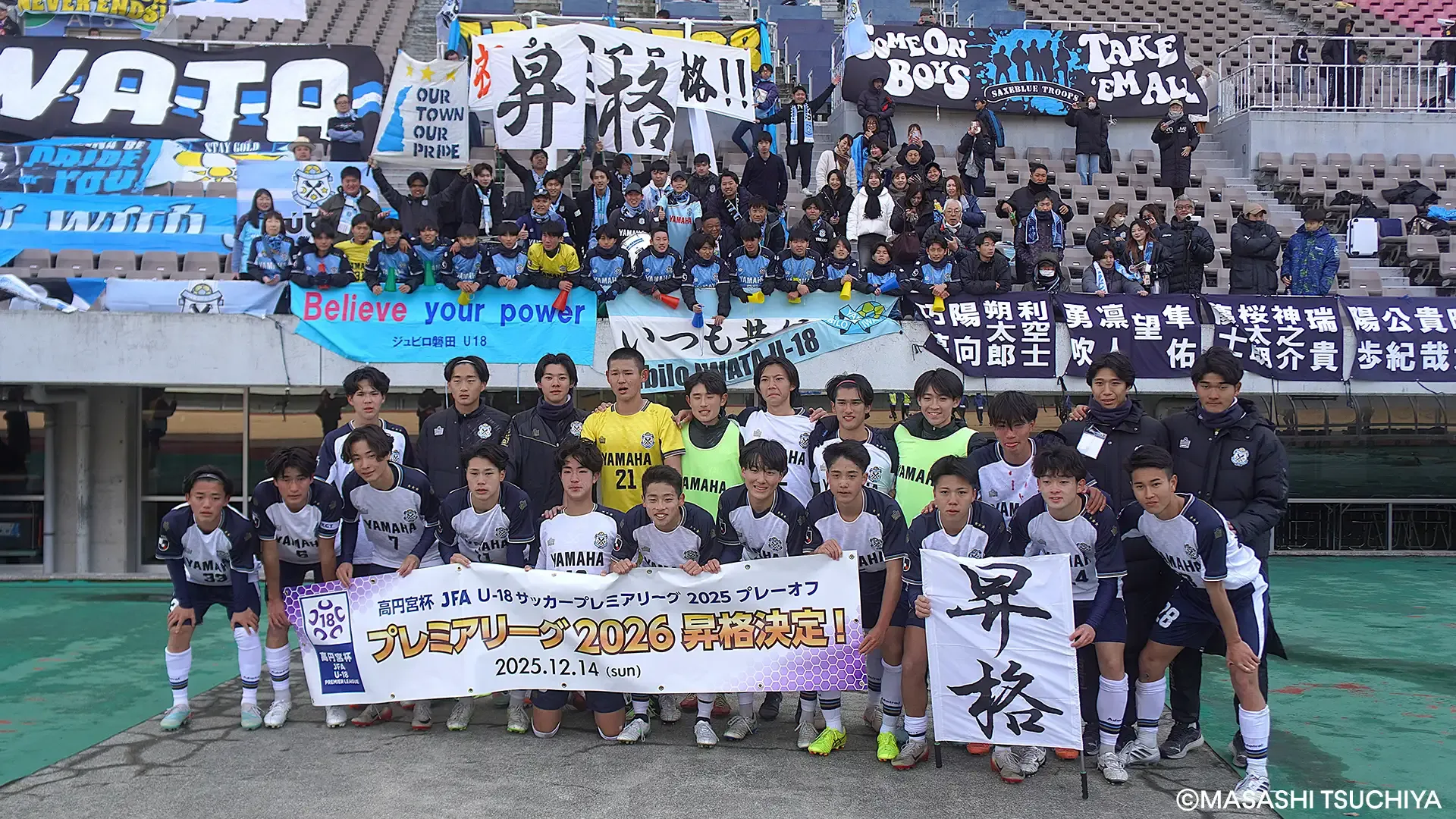
When the final whistle sounded and Kai saw the smiles on his team-mates’ faces, the tears came again — this time for a very different reason. Jubilo’s attack came alive in the play-off final against RB Omiya Ardija U18 as they ran out 5-1 winners, securing a return to the Premier League after three years away.
“I felt this huge sense of achievement, and I was so happy I couldn’t hold it in. More than anything, I wanted to win it for the third-years from the year before. I feel like it was the best possible way to finish my time in Jubilo’s academy.”
Watching from the stands was former U-18 head coach Takayoshi Anma, whom Kai and his team-mates regarded as a mentor. Anma had led the side until the end of September before taking charge of the first team following a change of manager but travelled to Hiroshima to see his former players’ final match.
“It was only nine months, but Coach Anma is probably the coach who’s left the biggest impression on me. He built the team from scratch, and I think a lot of us went into the match wanting to win it for him. So, I was really happy we could win in front of him. Seeing Coach Anma and everyone hugging and crying afterwards, I felt like that was the right way for us to finish.”
Those 180 minutes of play-off football brought Kai’s six years in Jubilo’s academy to the best possible close. A year after the disappointment at Hot Staff Field Hiroshima, the same ground rang with Saxe Blue celebrations.
■ A life built around football — ‘I know I’m improving’
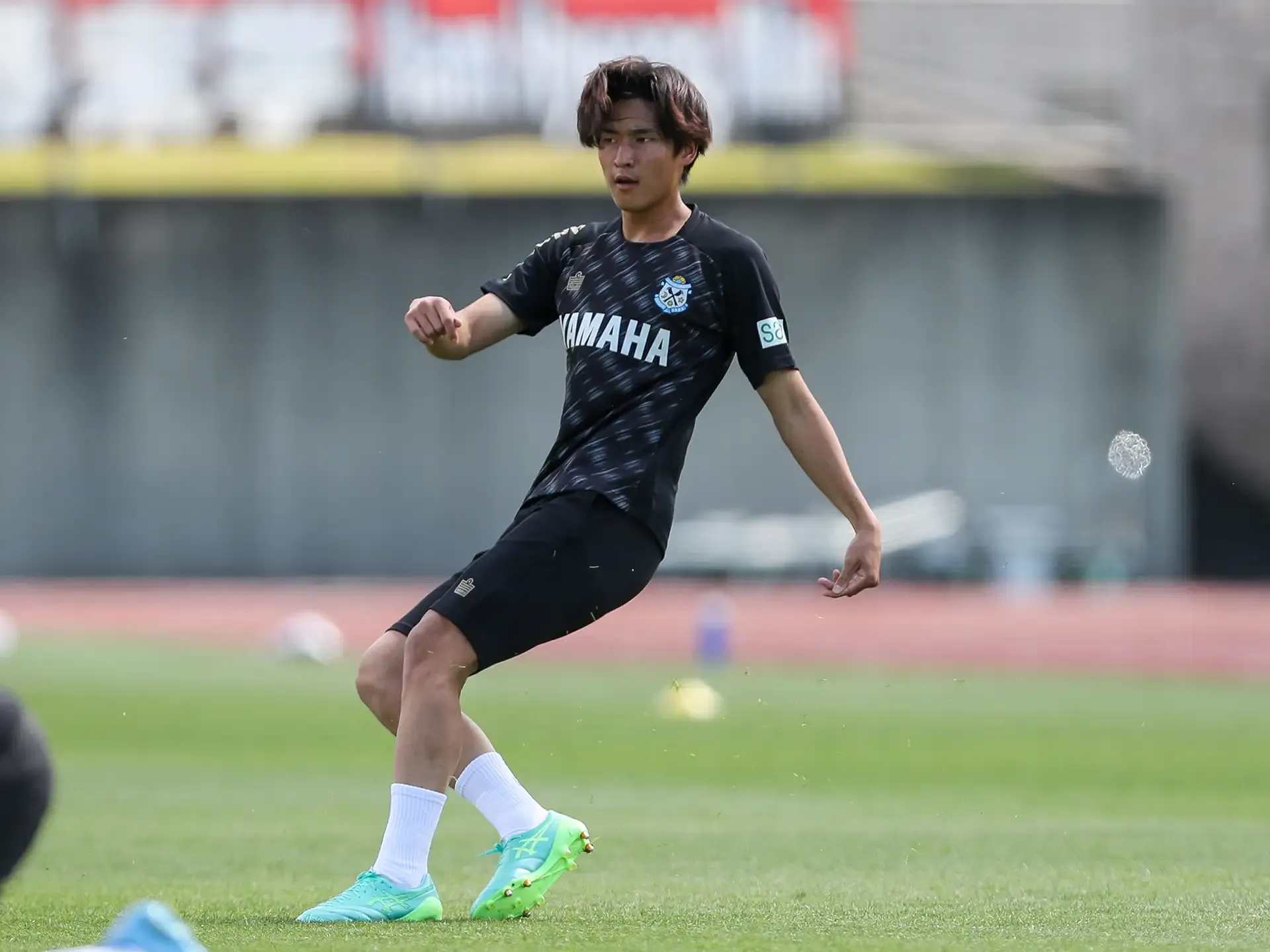
For Kai, 2026 marked the beginning of a life truly centred on football. Throwing all his energy into training every day is rewarding, but it also comes with a constant sense of urgency that keeps him on his toes.
In the MEIJI YASUDA J2/J3 100 YEAR VISION LEAGUE, which kicked off in February, Kai was named among the substitutes three times but did not make it onto the pitch. Seeing fellow new signings Ishizuka and Sora Masuda both get opportunities naturally leaves him eager for his own chance, but for now his focus is firmly on improving himself.
“Of course, there are still a lot of areas where I need to improve, both technically and physically. The results over the last six months have been really disappointing for me, so in the new season I want to play in as many matches and as many minutes as possible and help the team win.”
“I want to get results whenever I play in the U-21 J.League too. If I can’t get results wherever I play, I won’t be able to reach the next level. I’ve been putting in a lot of work since becoming a professional, and I feel I’m definitely improving, so I want to focus on getting results in every single match.”
Kai is well aware that he is still developing. From here, he will keep putting in the work, steadily and sincerely, determined one day to bring the Saxe Blue stands at Yamaha Stadium to their feet.
Free-spirited and poised to pounce, the Shizuoka-born defender nurtured by Jubilo carries a deep sense of gratitude into every kick and every step as he continues to write a story of his own.
Interview and text by Masashi Tsuchiya
